Which Tuling Protocol Is Best for the House
 Cover of beginning book edition, The Bully within the Minuscule and Antichrist | |
| Author | Unknown; plagiarised from various authors |
|---|---|
| Original title | Програма завоевания мира евреями ( Programa zavoevaniya mira evreyami ) "The Jewish Programme to Conquer the Globe" |
| Country | Russian Empire |
| Language | Russian[a] |
| Discipline | Antisemitic conspiracy theory |
| Genre | Propaganda |
| Publisher | Znamya |
| Publication date | Baronial–September 1903 |
| Published in English language | 1919 |
The Protocols of the Elders of Zion ( Протоколы сионских мудрецов ) or The Protocols of the Meetings of the Learned Elders of Zion is a fabricated antisemitic text purporting to describe a Jewish plan for global domination. The hoax was plagiarized from several before sources, some not antisemitic in nature.[one] Information technology was kickoff published in Russian federation in 1903, translated into multiple languages, and disseminated internationally in the early part of the 20th century. Information technology played a key part in popularizing belief in an international Jewish conspiracy.
Distillations of the work were assigned by some German teachers, as if factual, to be read by German schoolchildren subsequently the Nazis came to power in 1933,[ii] despite having been exposed equally fraudulent by the British newspaper The Times in 1921 and the German language Frankfurter Zeitung in 1924. Information technology remains widely bachelor in numerous languages, in impress and on the Internet, and continues to be presented by neofascist, fundamentalist and antisemitic groups as a genuine document. It has been described as "probably the about influential work of antisemitism always written".[3]
Creation
The Protocols is a fabricated document purporting to be factual. Textual prove shows that information technology could not have been produced prior to 1901. It is known that the title of Sergei Nilus' widely distributed edition contains the dates "1902–1903", and it is likely that the document was actually written at this time in Russia, despite Nilus' effort to cover this up by inserting French-sounding words into his edition.[4] Cesare K. De Michelis argues that it was manufactured in the months later on a Russian Zionist congress in September 1902, and that it was originally a parody of Jewish idealism meant for internal apportionment among antisemites until information technology was decided to clean it upwardly and publish it every bit if it were real. Self-contradictions in various testimonies show that the individuals involved—including the text'south initial publisher, Pavel Krushevan—deliberately obscured the origins of the text and lied about it in the decades afterward.[5]
If the placement of the forgery in 1902–1903 Russia is right, then it was written at the beginning of the anti-Jewish pogroms in the Russian Empire, in which thousands of Jews were killed or fled the country. Many of the people whom De Michelis suspects of interest in the forgery were directly responsible for inciting the pogroms.[6]
Political conspiracy background
Co-ordinate to Norman Cohn, the modern myth of a globe-wide conspiracy by Jews has its earliest precursor in a work written past a Jesuit priest, Augustin Barruel, who in his Mémoires pour servir à fifty'histoire du Jacobinisme (1798) argued that the medieval and multinational Order of the Knights Templar had not been completely extinguished in 1312 but rather lived on down the ages as a secret fraternity intent on destroying the papacy and all monarchical forms of government. In Barruel's view, the mod members of this occult move had wrested control of the Lodge of Freemasons he deemed responsible for undermining popular morality and the Catholic religion. Barruel'south ideas of a universal conspiracy were influenced by news of the contents of a tract, Proofs of a Conspiracy (1797), existence written by a Scottish mathematician John Robison in London. According to Barruel, the French Enlightenment thinkers, commanding a membership of one-half a million followers in French republic, in plough pledged their blind allegiance to the Bavarian Illuminati under Adam Weishaupt. The Jews rarely effigy in Barruel's v volume polemic, though several years afterwards, a letter written past a putative Florentine army officer going nether the name of J.B. Simonini, and addressed to Barruel, afterward complimenting him for having identified the infernal sects manoeuvering to pave the way for the Antichrist, added that the 'Judaic sect' should be included in the roster. The letter of the alphabet, Cohn concluded, 'seems to be the earliest in the series of anti-Semitic forgeries that was to culminate in the Protocols.'.[7] Simonini himself, according to Léon Poliakov, was probably a pseudonym masquerading the work of the French political law controlled past Joseph Fouché, mayhap in an attempt to thwart Napoleon's plans to convoke a Grand Sanhedrin and grant enfranchisement to the Jews.[8] Cohn'south reconstruction of the background is now contested.[ commendation needed ]
Towards the end of the 18th century, following the Partitions of Poland, the Russian Empire inherited the world'due south largest Jewish population. The Jews lived in shtetls in the Due west of the Empire, in the Pale of Settlement and until the 1840s, local Jewish affairs were organised through the qahal, the semi-autonomous Jewish regime, including for purposes of revenue enhancement and conscription into the Imperial Russian Regular army. Following the rising of liberalism in Europe, the Russian ruling class became more hardline in its reactionary policies, upholding the banner of Orthodoxy, Autocracy, and Nationality, whereby non-Orthodox and non-Russian subjects, including Jews, were not always embraced. Jews who attempted to digest were regarded with suspicion as potential "infiltrators" supposedly trying to "accept over guild", while Jews who remained fastened to traditional Jewish culture were resented as undesirable aliens.

The Book of the Kahal (1869) by Jacob Brafman, in the Russian linguistic communication original
Resentment towards Jews, for the aforementioned reasons, existed in Russian order, but the idea of a Protocols-esque international Jewish conspiracy for world domination was minted in the 1860s. Jacob Brafman, a Russian Jew from Minsk, had a falling out with agents of the local qahal and consequently turned against Judaism. He subsequently converted to the Russian Orthodox Church building and authored polemics against the Talmud and the qahal.[nine] Brafman claimed in his books The Local and Universal Jewish Brotherhoods (1868) and The Book of the Kahal (1869), published in Vilna, that the qahal continued to exist in secret and that it had every bit its primary aim undermining Christian entrepreneurs, taking over their property and ultimately seizing ability. He as well claimed that it was an international conspiratorial network, under the cardinal control of the Brotherhood Israélite Universelle, which was based in Paris and and so under the leadership of Adolphe Crémieux, a prominent freemason.[9] The Vilna Talmudist, Jacob Barit, attempted to abnegate Brafman's merits.
The impact of Brafman's work took on an international aspect when it was translated into English, French, German and other languages. The paradigm of the "qahal" as a secret international Jewish shadow government working as a state inside a land was picked up by anti-Jewish publications in Russia and was taken seriously past some Russian officials such as P. A. Cherevin and Nikolay Pavlovich Ignatyev who in the 1880s urged governors-full general of provinces to seek out the supposed qahal. This was effectually the time of the Narodnaya Volya assassination of Tsar Alexander II of Russian federation and the subsequent pogroms. In France, information technology was translated past Monsignor Ernest Jouin in 1925, who supported the Protocols. In 1928, Siegfried Passarge, a geographer who later gave his back up to the Nazis, translated information technology into German language.
Aside from Brafman, there were other early writings which posited a similar concept to the Protocols. This includes The Conquest of the World by the Jews (1878),[10] published in Basel and authored by Osman Bey (built-in Frederick Millingen). Millingen was a British subject and son of English physician Julius Michael Millingen, but served as an officer in the Ottoman Regular army where he was born. He converted to Islam, simply later became a Russian Orthodox Christian. Bey'south piece of work was followed up past Hippolytus Lutostansky's The Talmud and the Jews (1879) which claimed that Jews wanted to divide Russia amongst themselves.[xi]
Sources employed
Source material for the forgery consisted jointly of Dialogue aux enfers entre Machiavel et Montesquieu (Dialogue in Hell Between Machiavelli and Montesquieu), an 1864 political satire by Maurice Joly;[12] and a chapter from Biarritz, an 1868 novel by the antisemitic German novelist Hermann Goedsche, which had been translated into Russian in 1872.[two] : 97
Literary forgery
The Protocols is one of the all-time-known and most-discussed examples of literary forgery, with analysis and proof of its fraudulent origin dating as far back as 1921.[13] The forgery is an early case of "conspiracy theory" literature.[14] Written mainly in the first person plural,[b] the text includes generalizations, truisms, and platitudes on how to take over the world: accept control of the media and the financial institutions, change the traditional social society, etc. It does not contain specifics.[sixteen]
Maurice Joly
Numerous parts in the Protocols, in ane calculation, some 160 passages,[17] were plagiarized from Joly's fictional Dialogue in Hell, a thinly veiled assail on the political ambitions of Napoleon Three, who, represented by the non-Jewish graphic symbol Machiavelli,[xviii] plots to rule the world. Joly, a republican who afterward served in the Paris District, was sentenced to 15 months as a direct consequence of his book's publication.[19] Umberto Eco considered that Dialogue in Hell was itself plagiarised in part from a novel past Eugène Sue, Les Mystères du Peuple (1849–56).[twenty]
Identifiable phrases from Joly constitute 4% of the start one-half of the first edition, and 12% of the second half; subsequently editions, including most translations, have longer quotes from Joly.[21]
The Protocols 1–19 closely follow the lodge of Maurice Joly's Dialogues 1–17. For example:
| Dialogue in Hell Between Machiavelli and Montesquieu | The Protocols of the Elders of Zion |
|---|---|
|
|
|
|
|
|
Philip Graves brought this plagiarism to light in a series of articles in The Times in 1921, being the first to betrayal the Protocols as a forgery to the public.[1] [22]
Hermann Goedsche
Daniel Keren wrote in his essay "Commentary on The Protocols of the Elders of Zion", "Goedsche was a postal clerk and a spy for the Prussian Secret Police. He had been forced to leave the postal piece of work due to his function in forging prove in the prosecution against the Autonomous leader Benedict Waldeck in 1849."[23] Following his dismissal, Goedsche began a career as a conservative columnist, and wrote literary fiction under the pen name Sir John Retcliffe.[24] His 1868 novel Biarritz (To Sedan) contains a chapter called "The Jewish Cemetery in Prague and the Council of Representatives of the Twelve Tribes of Israel." In it, Goedsche (who was unaware that just ii of the original twelve Biblical "tribes" remained) depicts a hugger-mugger nocturnal meeting of members of a mysterious rabbinical cabal that is planning a diabolical "Jewish conspiracy." At midnight, the Devil appears to contribute his opinions and insight. The affiliate closely resembles a scene in Alexandre Dumas' Giuseppe Balsamo (1848), in which Joseph Balsamo a.k.a. Alessandro Cagliostro and company plot the Affair of the Diamond Necklace.[25]
In 1872, a Russian translation of "The Jewish Cemetery in Prague" appeared in Saint Petersburg every bit a separate pamphlet of purported non-fiction. François Bournand, in his Les Juifs et nos Contemporains (1896), reproduced the soliloquy at the end of the chapter, in which the character Levit expresses as factual the wish that Jews exist "kings of the world in 100 years" —crediting a "Primary Rabbi John Readcliff." Perpetuation of the myth of the authenticity of Goedsche's story, in particular the "Rabbi's speech", facilitated later accounts of the equally mythical authenticity of the Protocols.[24] Like the Protocols, many asserted that the fictional "rabbi's speech" had a ring of actuality, regardless of its origin: "This voice communication was published in our time, eighteen years ago," read an 1898 written report in La Croix, "and all the events occurring earlier our eyes were anticipated in it with truly frightening accuracy."[26]
Fictional events in Joly's Dialogue aux enfers entre Machiavel et Montesquieu, which appeared four years before Biarritz, may well accept been the inspiration for Goedsche's fictional midnight meeting, and details of the outcome of the supposed plot. Goedsche's chapter may have been an outright plagiarism of Joly, Dumas père, or both.[27] [c]
Structure and content
The Protocols purports to document the minutes of a late-19th-century meeting attended by world Jewish leaders, the "Elders of Zion", who are conspiring to take over the globe.[28] [29] The forgery places in the mouths of the Jewish leaders a diverseness of plans, nigh of which derive from older antisemitic canards.[28] [29] For case, the Protocols includes plans to subvert the morals of the non-Jewish world, plans for Jewish bankers to command the earth's economies, plans for Jewish control of the press, and – ultimately – plans for the destruction of civilization.[28] [29] The document consists of 24 "protocols", which accept been analyzed past Steven Jacobs and Mark Weitzman, who documented several recurrent themes that appear repeatedly in the 24 protocols,[d] every bit shown in the following tabular array:[30]
| Protocol | Title[30] | Themes[30] |
|---|---|---|
| 1 | The Basic Doctrine: "Right Lies in Might" | Liberty and Freedom; Authorisation and power; Gold=money |
| 2 | Economic State of war and Disorganization Pb to International Regime | International Political economic conspiracy; Press/Media equally tools |
| 3 | Methods of Conquest | Jewish people, arrogant and decadent; Chosenness/Election; Public Service |
| 4 | The Devastation of Religion by Materialism | Business organisation as Common cold and Heartless; Gentiles as slaves |
| v | Despotism and Modernistic Progress | Jewish Ideals; Jewish People's Relationship to Larger Lodge |
| 6 | The Acquisition of State, The Encouragement of Speculation | Buying of land |
| 7 | A Prophecy of Worldwide State of war | Internal unrest and discord (vs. Court system) leading to war vs Shalom/Peace |
| 8 | The transitional Government | Criminal element |
| 9 | The Across-the-board Propaganda | Law; education; Freemasonry |
| x | Abolition of the Constitution; Ascension of the Autocracy | Politics; Bulk dominion; Liberalism; Family |
| 11 | The Constitution of Autocracy and Universal Rule | Gentiles; Jewish political interest; Freemasonry |
| 12 | The Kingdom of the Press and Command | Liberty; Press censorship; Publishing |
| thirteen | Turning Public Thought from Essentials to Non-essentials | Gentiles; Concern; Chosenness/Ballot; Press and censorship; Liberalism |
| xiv | The Devastation of Faith every bit a Prelude to the Rise of the Jewish God | Judaism; God; Gentiles; Liberty; Pornography |
| xv | Utilization of Masonry: Heartless Suppression of Enemies | Gentiles; Freemasonry; Sages of Israel; Political power and potency; Male monarch of Israel |
| 16 | The Nullification of Didactics | Education |
| 17 | The Fate of Lawyers and the Clergy | Lawyers; Clergy; Christianity and non-Jewish Authorship |
| 18 | The Organization of Disorder | Evil; Speech; |
| 19 | Mutual Understanding Between Ruler and People | Gossip; Martyrdom |
| xx | The Financial Program and Construction | Taxes and Taxation; Loans; Bonds; Usury; Moneylending |
| 21 | Domestic Loans and Government Credit | Stock Markets and Stock Exchanges |
| 22 | The Beneficence of Jewish Rule | Golden=Money; Chosenness/Ballot |
| 23 | The Inculcation of Obedience | Obedience to Dominance; Slavery; Chosenness/Election |
| 24 | The Jewish Ruler | Kingship; Document as Fiction |
Conspiracy references
According to Daniel Pipes,
The volume's vagueness—about no names, dates, or issues are specified—has been one cardinal to this broad-ranging success. The purportedly Jewish authorship besides helps to make the volume more disarming. Its embrace of contradiction—that to advance, Jews use all tools available, including commercialism and communism, philo-Semitism and antisemitism, commonwealth and tyranny—made it possible for The Protocols to attain out to all: rich and poor, Right and Left, Christian and Muslim, American and Japanese.[sixteen]
Pipes notes that the Protocols emphasizes recurring themes of conspiratorial antisemitism: "Jews always scheme", "Jews are everywhere", "Jews are behind every institution", "Jews obey a primal authorisation, the shadowy 'Elders'", and "Jews are close to success."[31]
Equally fiction in the genre of literature, the tract was analyzed by Umberto Eco in his novel Foucault's Pendulum (1988):
The groovy importance of The Protocols lies in its permitting antisemites to reach across their traditional circles and find a large international audition, a process that continues to this day. The forgery poisoned public life wherever it appeared; it was "cocky-generating; a blueprint that migrated from i conspiracy to another."[32]
Eco likewise dealt with the Protocols in 1994 in chapter 6, "Fictional Protocols", of his Six Walks in the Fictional Woods and in his 2010 novel The Cemetery of Prague.
History
Publication history
The Protocols appeared in impress in the Russian Empire equally early as 1903, published as a series of articles in Znamya, a Black Hundreds paper owned by Pavel Krushevan. Information technology appeared over again in 1905 every bit the final chapter (Chapter XII) of the second edition of Velikoe v malom i antikhrist ("The Great in the Small & Antichrist"), a book by Sergei Nilus. In 1906, it appeared in pamphlet grade edited past Georgy Butmi de Katzman.[33]
These first iii (and later more) Russian language imprints were published and circulated in the Russian Empire during the 1903–06 period every bit a tool for scapegoating Jews, blamed past the monarchists for the defeat in the Russo-Japanese War and the Revolution of 1905. Mutual to all iii texts is the thought that Jews aim for globe domination. Since The Protocols are presented equally merely a document, the front thing and back matter are needed to explain its alleged origin. The diverse imprints, nevertheless, are mutually inconsistent. The full general claim is that the document was stolen from a secret Jewish organization. Since the alleged original stolen manuscript does not exist, 1 is forced to restore a purported original edition. This has been washed by the Italian scholar, Cesare G. De Michelis in 1998, in a work which was translated into English and published in 2004, where he treats his subject as Apocrypha.[33] [34]
As the Russian Revolution unfolded, causing White motion-affiliated Russians to flee to the W, this text was carried along and assumed a new purpose. Until then, The Protocols had remained obscure;[34] it at present became an instrument for blaming Jews for the Russian Revolution. It became a tool, a political weapon, used against the Bolsheviks who were depicted as overwhelmingly Jewish, allegedly executing the "programme" embodied in The Protocols. The purpose was to discredit the October Revolution, preclude the W from recognizing the Soviet Union, and bring about the downfall of Vladimir Lenin's regime.[33] [34]
First Russian language editions
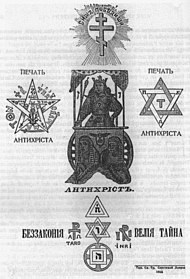
The frontispiece of a 1912 edition using occult symbols
The chapter "In the Jewish Cemetery in Prague" from Goedsche's Biarritz, with its strong antisemitic theme containing the alleged rabbinical plot confronting the European civilization, was translated into Russian as a carve up pamphlet in 1872.[2] : 97 However, in 1921, Princess Catherine Radziwill gave a individual lecture in New York in which she claimed that the Protocols were a forgery compiled in 1904–05 by Russian journalists Matvei Golovinski and Manasevich-Manuilov at the management of Pyotr Rachkovsky, Primary of the Russian secret service in Paris.[35]
In 1944, German author Konrad Heiden identified Golovinski as an author of the Protocols.[36] Radziwill's account was supported past Russian historian Mikhail Lepekhine, who published his findings in November 1999 in the French newsweekly L'Express.[37] Lepekhine considers the Protocols a office of a scheme to persuade Tsar Nicholas II that the modernization of Russian federation was really a Jewish plot to command the world.[38] Stephen Eric Bronner writes that groups opposed to progress, parliamentarianism, urbanization, and capitalism, and an active Jewish role in these mod institutions, were particularly drawn to the antisemitism of the document.[39] Ukrainian scholar Vadim Skuratovsky offers extensive literary, historical and linguistic assay of the original text of the Protocols and traces the influences of Fyodor Dostoyevsky'due south prose (in item, The Grand Inquisitor and The Possessed) on Golovinski's writings, including the Protocols.[38]
Golovinski'south role in the writing of the Protocols is disputed by Michael Hagemeister, Richard Levy and Cesare De Michelis, who each write that the account which involves him is historically unverifiable and to a big extent provably wrong.[40] [41] [42]
In his book The Non-Existent Manuscript, Italian scholar Cesare G. De Michelis studies early Russian publications of the Protocols. The Protocols were start mentioned in the Russian press in Apr 1902, by the St. petersburg paper Novoye Vremya ( Новое Время – The New Times). The article was written by famous conservative publicist Mikhail Menshikov as a part of his regular series "Letters to Neighbors" ("Письма к ближним") and was titled "Plots against Humanity". The author described his coming together with a lady (Yuliana Glinka, every bit information technology is known now) who, after telling him about her mystical revelations, implored him to get familiar with the documents afterward known as the Protocols; but afterward reading some excerpts, Menshikov became quite skeptical virtually their origin and did not publish them.[43]
Krushevan and Nilus editions
The Protocols were published at the earliest, in serialized form, from Baronial 28 to September seven (O.South.) 1903, in Znamya, a St. petersburg daily newspaper, nether Pavel Krushevan. Krushevan had initiated the Kishinev pogrom four months earlier.[44]
In 1905, Sergei Nilus published the full text of the Protocols in Chapter XII, the final chapter (pp. 305–417), of the 2nd edition (or tertiary, according to some sources) of his book, Velikoe five malom i antikhrist, which translates as "The Great within the Small: The Coming of the Anti-Christ and the Dominion of Satan on Earth". He claimed information technology was the work of the First Zionist Congress, held in 1897 in Basel, Switzerland.[33] When information technology was pointed out that the Showtime Zionist Congress had been open to the public and was attended by many non-Jews, Nilus inverse his story, proverb the Protocols were the piece of work of the 1902–03 meetings of the Elders, only contradicting his own prior argument that he had received his copy in 1901:
In 1901, I succeeded through an acquaintance of mine (the late Court Marshal Alexei Nikolayevich Sukotin of Chernigov) in getting a manuscript that exposed with unusual perfection and clarity the grade and evolution of the clandestine Jewish Freemasonic conspiracy, which would bring this wicked world to its inevitable end. The person who gave me this manuscript guaranteed it to exist a faithful translation of the original documents that were stolen by a adult female from one of the highest and most influential leaders of the Freemasons at a secret meeting somewhere in France—the honey nest of Freemasonic conspiracy.[45]
Stolypin'southward fraud investigation, 1905
A subsequent secret investigation ordered by Pyotr Stolypin, the newly appointed chairman of the Council of Ministers, came to the determination that the Protocols start appeared in Paris in antisemitic circles around 1897–98.[46] When Nicholas Two learned of the results of this investigation, he requested, "The Protocols should exist confiscated, a skilful cause cannot be dedicated by dirty means."[47] Despite the society, or considering of the "adept cause", numerous reprints proliferated.[44]
The Protocols in the West
In February 1920, Eyre & Spottiswoode published the starting time English translation of The Protocols of the Elders of Zion in United kingdom of great britain and northern ireland. Co-ordinate to a letter written by art historian Robert Hobart Cust, the pamphlet had been translated, prepared, and paid for by George Shanks[48] and their mutual friend, Major Edward Griffiths George Burdon, who was serving as Secretary of the United Russian federation Societies Association at that time.[49] In an edition of Lord Alfred Douglas' Plain English periodical dated Jan 1921,[l] it is claimed that Shanks, a former officeholder in the Royal Navy Air Service and the Russian Government Committee in Kingsway, London,[51] had constitute post-war employment in the Principal Whip's Office at 12 Downing Street, earlier being offered a position as Personal Secretary to Sir Philip Sassoon, at that time serving every bit Individual Secretarial assistant to British Prime Minister David Lloyd George in Britain'south Coalition Government.
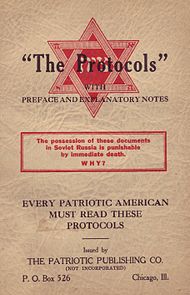
A 1934 edition past the Patriotic Publishing Company of Chicago
In the U.s., The Protocols are to be understood in the context of the First Red Scare (1917–20). The text was purportedly brought to the Usa by a Russian Army officeholder in 1917; it was translated into English by Natalie de Bogory (personal banana of Harris A. Houghton, an officer of the Section of War) in June 1918,[52] and Russian departer Boris Brasol shortly circulated it in American authorities circles, specifically diplomatic and military, in typescript form,[53] a copy of which is archived by the Hoover Institute.[54] It also appeared in 1919 in the Public Ledger as a pair of serialized newspaper articles. But all references to "Jews" were replaced with references to Bolsheviki as an exposé past the journalist and subsequently highly respected Columbia Academy School of Journalism dean Carl W. Ackerman.[55] [54]
In 1923, there appeared an anonymously edited pamphlet past the Britons Publishing Society, a successor to The Britons, an entity created and headed by Henry Hamilton Beamish. This banner was allegedly a translation by Victor East. Marsden, who had died in October 1920.[54]
English language imprints
On Oct 27 and 28, 1919, the Philadelphia Public Ledger published excerpts of an English linguistic communication translation equally the "Red Bible," deleting all references to the purported Jewish authorship and re-casting the document as a Bolshevik manifesto.[56] The author of the articles was the newspaper's correspondent at the time, Carl W. Ackerman, who subsequently became the head of the journalism department at Columbia University. On May 8, 1920, an article[57] in The Times followed German translation and appealed for an inquiry into what information technology called an "uncanny note of prophecy". In the leader (editorial) titled "The Jewish Peril, a Agonizing Pamphlet: Call for Inquiry", Wickham Steed wrote nearly The Protocols:
What are these 'Protocols'? Are they authentic? If so, what malevolent assembly concocted these plans and gloated over their exposition? Are they forgery? If so, whence comes the uncanny note of prophecy, prophecy in part fulfilled, in part and then far gone in the mode of fulfillment?[58]
Steed retracted his endorsement of The Protocols after they were exposed as a forgery.[59]
U.s.

Title folio of 1920 edition from Boston
For nearly 2 years starting in 1920, the American industrialist Henry Ford published in a newspaper he owned — The Dearborn Independent — a serial of antisemitic articles that quoted liberally from the Protocols.[60] The actual writer of the manufactures is more often than not believed to have been the newspaper'southward editor William Cameron.[threescore] During 1922, the circulation of the Dearborn Independent grew to almost 270,000 paid copies.[61] Ford later published a compilation of the articles in book form as "The International Jew: The World's Foremost Problem".[60] In 1921, Ford cited show of a Jewish threat: "The only statement I care to make most the Protocols is that they fit in with what is going on. They are 16 years erstwhile, and they take fitted the earth situation up to this time."[62] Robert A. Rosenbaum wrote that "In 1927, bowing to legal and economic pressure level, Ford issued a retraction and amends—while disclaiming personal responsibility—for the anti-Semitic articles and closed the Dearborn Independent in 1927.[63] He was also an admirer of Nazi Germany.[64]
In 1934, an bearding editor expanded the compilation with "Text and Commentary" (pp 136–41). The production of this uncredited compilation was a 300-page book, an inauthentic expanded edition of the twelfth chapter of Nilus'southward 1905 volume on the coming of the anti-Christ. Information technology consists of substantial liftings of excerpts of manufactures from Ford'southward antisemitic journal The Dearborn Independent. This 1934 text circulates most widely in the English language-speaking world, likewise equally on the internet. The "Text and Commentary" concludes with a annotate on Chaim Weizmann's Oct vi, 1920, remark at a banquet: "A beneficent protection which God has instituted in the life of the Jew is that He has dispersed him all over the world". Marsden, who was dead by and so, is credited with the following assertion:
It proves that the Learned Elders exist. It proves that Dr. Weizmann knows all about them. It proves that the desire for a "National Home" in Palestine is just cover-up and an infinitesimal function of the Jew'south real object. It proves that the Jews of the globe have no intention of settling in Palestine or any separate country, and that their almanac prayer that they may all encounter "Next Year in Jerusalem" is merely a piece of their characteristic make-believe. It also demonstrates that the Jews are now a world menace, and that the Aryan races will have to dwelling house them permanently out of Europe.[65]
The Times exposes a forgery, 1921
In 1920–1921, the history of the concepts establish in the Protocols was traced back to the works of Goedsche and Jacques Crétineau-Joly by Lucien Wolf (an English language Jewish journalist), and published in London in August 1921. Simply a dramatic exposé occurred in the serial of manufactures in The Times by its Constantinople reporter, Philip Graves, who discovered the plagiarism from the piece of work of Maurice Joly.[1]
According to writer Peter Grose, Allen Dulles, who was in Constantinople developing relationships in post-Ottoman political structures, discovered "the source" of the documentation and ultimately provided him to The Times. Grose writes that The Times extended a loan to the source, a Russian émigré who refused to be identified, with the agreement the loan would not be repaid.[66] Colin Holmes, a lecturer in economical history at Sheffield University, identified the émigré equally Mikhail Raslovlev, a self-identified antisemite, who gave the information to Graves so equally not to "give a weapon of any kind to the Jews, whose friend I have never been."[67]
In the first article of Graves' series, titled "A Literary Forgery", the editors of The Times wrote, "our Constantinople Correspondent presents for the first time conclusive proof that the document is in the main a clumsy plagiarism. He has forwarded us a copy of the French book from which the plagiarism is made."[one] In the aforementioned year, an entire book[68] documenting the hoax was published in the Us by Herman Bernstein. Despite this widespread and extensive debunking, the Protocols continued to be regarded as of import factual testify by antisemites. Dulles, a successful lawyer and career diplomat, attempted to persuade the US State Department to publicly denounce the forgery, simply without success.[69]
Switzerland
The Berne Trial, 1934–35
The selling of the Protocols (edited by German antisemite Theodor Fritsch) by the National Front during a political meeting in the Casino of Berne on June 13, 1933,[e] led to the Berne Trial in the Amtsgericht (district court) of Berne, the capital of Switzerland, on October 29, 1934. The plaintiffs (the Swiss Jewish Association and the Jewish Community of Berne) were represented past Hans Matti and Georges Brunschvig, helped by Emil Raas. Working on behalf of the defence force was German antisemitic propagandist Ulrich Fleischhauer. On May 19, 1935, 2 defendants (Theodore Fischer and Silvio Schnell) were convicted of violating a Bernese statute prohibiting the distribution of "immoral, obscene or brutalizing" texts[70] while 3 other defendants were acquitted. The courtroom declared the Protocols to be forgeries, plagiarisms, and obscene literature. Gauge Walter Meyer, a Christian who had non previously heard of the Protocols, said in conclusion,
I hope the time will come up when nobody will be able to understand how in 1935 nearly a dozen sane and responsible men were able for two weeks to mock the intellect of the Bern court discussing the authenticity of the so-called Protocols, the very Protocols that, harmful equally they have been and will be, are nothing but laughable nonsense.[44]
Vladimir Burtsev, a Russian émigré, anti-Bolshevik and anti-Fascist who exposed numerous Okhrana agents provocateurs in the early on 1900s, served every bit a witness at the Berne Trial. In 1938 in Paris he published a book, The Protocols of the Elders of Zion: A Proved Forgery, based on his testimony.
On November 1, 1937, the defendants appealed the verdict to the Obergericht (Cantonal Supreme Court) of Berne. A panel of 3 judges acquitted them, holding that the Protocols, while false, did not violate the statute at issue considering they were "political publications" and not "immoral (obscene) publications (Schundliteratur)" in the strict sense of the law.[70] The presiding gauge's opinion stated, though, that the forgery of the Protocols was not questionable and expressed regret that the law did not provide acceptable protection for Jews from this sort of literature. The courtroom refused to impose the fees of defence force of the acquitted defendants to the plaintiffs, and the acquitted Theodor Fischer had to pay 100 Fr. to the total state costs of the trial (Fr. 28,000) that were eventually paid by the County of Berne.[71] This determination gave grounds for later allegations that the appeal court "confirmed authenticity of the Protocols" which is contrary to the facts. A view favorable to the pro-Nazi defendants is reported in an appendix to Leslie Fry's Waters Flowing Eastward.[72] A more scholarly piece of work on the trial is in a 139-folio monograph by Urs Lüthi.[73]
Show presented at the trial, which strongly influenced later on accounts up to the present, was that the Protocols were originally written in French by agents of the Tzarist secret constabulary (the Okhrana).[42] However, this version has been questioned past several modernistic scholars.[42] Michael Hagemeister discovered that the primary witness Alexandre du Chayla had previously written in support of the blood libel, had received iv thousand Swiss francs for his testimony, and was secretly doubted even by the plaintiffs.[41] Charles Ruud and Sergei Stepanov concluded that at that place is no substantial evidence of Okhrana involvement and potent circumstantial evidence against information technology.[74]
The Basel Trial
A like trial in Switzerland took place at Basel. The Swiss Frontists Alfred Zander and Eduard Rüegsegger distributed the Protocols (edited by the German Gottfried zur Beek) in Switzerland. Jules Dreyfus-Brodsky and Marcus Cohen sued them for insult to Jewish award. At the aforementioned time, chief rabbi Marcus Ehrenpreis of Stockholm (who also witnessed at the Berne Trial) sued Alfred Zander who contended that Ehrenpreis himself had said that the Protocols were authentic (referring to the foreword of the edition of the Protocols by the German antisemite Theodor Fritsch). On June 5, 1936, these proceedings ended with a settlement.[f]
Federal republic of germany
Co-ordinate to historian Norman Cohn,[76] the assassins of High german Jewish politico Walter Rathenau (1867–1922) were convinced that Rathenau was a literal "Elder of Zion".
Information technology seems probable Adolf Hitler commencement became enlightened of the Protocols after hearing nearly it from ethnic German language white émigrés, such as Alfred Rosenberg and Max Erwin von Scheubner-Richter.[77] Rosenberg and Scheubner-Richter were besides members of the early Aufbau Vereinigung counterrevolutionary grouping, which according to historian Michael Kellogg, influenced the Nazis in promulgating a Protocols-like myth.[78]
Hitler refers to the Protocols in Mein Kampf:
... [The Protocols] are based on a forgery, the Frankfurter Zeitung moans [ ] every week ... [which is] the best proof that they are authentic ... the important matter is that with positively terrifying certainty they reveal the nature and action of the Jewish people and expose their inner contexts besides as their ultimate concluding aims.[79]
The Protocols also became a part of the Nazi propaganda endeavor to justify persecution of the Jews. In The Holocaust: The Destruction of European Jewry 1933–1945, Nora Levin states that "Hitler used the Protocols equally a manual in his war to exterminate the Jews":
Despite conclusive proof that the Protocols were a gross forgery, they had sensational popularity and big sales in the 1920s and 1930s. They were translated into every language of Europe and sold widely in Arab lands, the US, and England. But information technology was in Germany after World State of war I that they had their greatest success. There they were used to explain all of the disasters that had befallen the country: the defeat in the war, the hunger, the destructive inflation.[80]
Hitler did not mention the Protocols in his speeches after his defense of information technology in Mein Kampf.[42] [81] "Distillations of the text appeared in German classrooms, indoctrinated the Hitler Youth, and invaded the USSR along with German soldiers."[2] Nazi Propaganda Minister Joseph Goebbels proclaimed: "The Zionist Protocols are equally upward-to-date today as they were the day they were first published."[82]
Richard S. Levy criticizes the claim that the Protocols had a big effect on Hitler's thinking, writing that it is based more often than not on doubtable testimony and lacks hard prove.[42] Randall Bytwerk agrees, writing that most leading Nazis did not believe it was genuine despite having an "inner truth" suitable for propaganda.[81]
Publication of the Protocols was stopped in Germany in 1939 for unknown reasons.[83] An edition that was set for printing was blocked by censorship laws.[84]
German language-language publications
Having fled Ukraine in 1918–19, Piotr Shabelsky-Bork brought the Protocols to Ludwig Muller Von Hausen who and so published them in German.[85] Under the pseudonym Gottfried Zur Beek he produced the first and "by far the most important"[86] German language translation. It appeared in January 1920 as a office of a larger antisemitic tract[87] dated 1919. After The Times discussed the volume respectfully in May 1920 it became a bestseller. "The Hohenzollern family helped defray the publication costs, and Kaiser Wilhelm Ii had portions of the book read out aloud to dinner guests".[82] Alfred Rosenberg'southward 1923 edition[88] "gave a forgery a huge boost".[82]
Italian republic
Fascist politician Giovanni Preziosi published the commencement Italian edition of the Protocols in 1921.[89] [ page needed ] The volume notwithstanding had little affect until the mid-1930s. A new 1937 edition had a much higher impact, and three farther editions in the following months sold 60,000 copies total.[89] [ page needed ] The fifth edition had an introduction past Julius Evola, which argued around the issue of forgery, stating: "The problem of the authenticity of this document is secondary and has to be replaced by the much more serious and essential problem of its truthfulness".[89] [ page needed ]
Post World War II
Middle East
Neither governments nor political leaders in about parts of the world have referred to the Protocols since Globe War II. The exception to this is the Middle East, where a large number of Arab and Muslim regimes and leaders have endorsed them as authentic, including endorsements from Presidents Gamal Abdel Nasser and Anwar Sadat of Egypt, President Abdul Salam Arif of Iraq,[90] King Faisal of Saudi Arabia, and Colonel Muammar al-Gaddafi of Libya.[91] [92] A translation made by an Arab Christian appeared in Cairo in 1927 or 1928, this time equally a book. The first translation by an Arab Muslim was too published in Cairo, but simply in 1951.[91]
The 1988 charter of Hamas, a Palestinian Islamist group, stated that the Protocols embodies the plan of the Zionists.[93] The reference was removed in the new covenant issued in 2017.[94] Recent endorsements in the 21st century accept been made by the Thousand Mufti of Jerusalem, Sheikh Ekrima Sa'id Sabri, the education ministry building of Saudi Arabia,[92] and a member of the Greek Parliament, Ilias Kasidiaris.[95] The Palestinian Solidarity Committee of Due south Africa reportedly distributed copies of the Protocols at the Earth Conference confronting Racism 2001.[96] The book was sold during the conference in the exhibition tent ready for the distribution of the antiracist literature.[97] [98]
However, figures within the region accept publicly asserted that The Protocols of the Elders of Zion is a forgery such as onetime Grand Mufti of Egypt Ali Gomaa, who made an official courtroom complaint concerning a publisher who falsely put his name on an introduction to its Arabic translation.[99]
Contemporary conspiracy theories
The Protocols keep to be widely available around the world, particularly on the Internet.
The Protocols is widely considered influential in the development of other conspiracy theories,[ citation needed ] and reappears repeatedly in contemporary conspiracy literature. Notions derived from the Protocols include claims that the "Jews" depicted in the Protocols are a embrace for the Illuminati,[36] Freemasons, the Priory of Sion or, in the stance of David Icke, "actress-dimensional entities".[100] In his volume And the truth shall fix you gratuitous (1995), Icke asserted that the Protocols are genuine and accurate.[101]
Adaptations
Masami Uno's book If You Understand Judea Y'all Can Comprehend the World: 1990 Scenario for the 'Final Economic War' became popular in Japan around 1987 and was based upon the Protocols.[102]
Television
In 2001–2002, Arab Radio and Television produced a xxx-function tv miniseries entitled Horseman Without a Horse, starring prominent Egyptian histrion Mohamed Sobhi, which contains dramatizations of the Protocols. The United States and Israel criticized Arab republic of egypt for ambulation the program.[103] Ash-Shatat (Standard arabic: الشتات The Diaspora) is a 29-part Syrian boob tube series produced in 2003 past a private Syrian film company and was based in part on the Protocols. Syrian national television receiver declined to air the program. Ash-Shatat was shown on Lebanese republic's Al-Manar, before existence dropped. The serial was shown in Iran in 2004, and in Jordan during October 2005 on Al-Mamnou, a Jordanian satellite network.[ citation needed ]
Notes
- ^ With plagiarism from German and French texts
- ^ The text contains 44 instances of the word "I" (9.half dozen%), and 412 instances of the word "we" (90.four%).[15]
- ^ This complex relationship was originally exposed by Graves 1921. The exposé has since been elaborated in many sources.
- ^ Jacobs analyses the Marsden English translation. Some other less common imprints have more or fewer than 24 protocols.
- ^ The chief speaker was the former chief of the Swiss General Staff Emil Sonderegger.
- ^ Zander had to withdraw his contention and the stock of the incriminated Protocols were destroyed past club of the court. Zander had to pay the fees of this Basel Trial.[75]
References
Citations
- ^ a b c d Graves 1921.
- ^ a b c d Segel, Binjamin (1995). A Lie and a Libel: The History of the Protocols of the Elders of Zion. Translated by Levy, Richard S. University of Nebraska Printing. p. 30. ISBN0803242433.
- ^ Bronner 2003, p. one.
- ^ De Michelis 2004, p. 65.
- ^ De Michelis 2004, pp. 76–80.
- ^ Hadassa Ben-Itto, The Prevarication that Wouldn't Die: The Protocols of The Elders of Zion, p. 280 (London: Vallentine Mitchell, 2005). ISBN 0-85303-602-0
- ^ Cohn 1970 p.31.
- ^ Norman Cohn, Warrant for Genocide, Pelican Books (1967) 1970 pp.30-32
- ^ a b Petrovsky-Shtern 2011, p. 60.
- ^ Donskis, Leonidas (2003). Forms of Hatred: The Troubled Imagination in Mod Philosophy and Literature. Rodopi. ISBN978-9042010666.
- ^ "Ritual murder encouraged..." The New York Times. August 27, 1911.
- ^ Jacobs & Weitzman 2003, p. 15.
- ^ A Hoax of Hate, Jewish Virtual Library .
- ^ Boym, Svetlana (1999), "Conspiracy theories and literary ethics: Umberto Eco, Danilo Kis and 'The Protocols of Zion'", Comparative Literature, 51 (Leap): 97–122, doi:10.2307/1771244, JSTOR 1771244 .
- ^ The Protocols of the Learned Elders of Zion, Marsden, VE transl, Shoah didactics
{{citation}}: CS1 maint: others (link) [ permanent dead link ] . - ^ a b Pipes 1997, p. 85.
- ^ Cohn, Warrant for Genocide, 1970 p.82.
- ^ Ye'r, Bat; Kochan, Miriam; Littman, David (2001), Islam and Dhimmitude, The states: Fairleigh Dickinson University Press, p. 142, ISBN978-0-8386-3942-ix .
- ^ Bronner, Stephen Eric (2018-08-xxx). A Rumor virtually the Jews: Conspiracy, Anti-Semitism, and the Protocols of Zion. Springer. pp. 68–70. ISBN978-3-319-95396-0.
- ^ Eco, Umberto (1994), "Fictional Protocols", Half dozen Walks in the Fictional Forest, Cambridge, MA: Harvard Academy Press, p. 135, ISBN978-0-674-81050-1
- ^ De Michelis 2004, p. viii.
- ^ Bein, Alex (1990), The Jewish question: biography of a world trouble, Fairleigh Dickinson Univ Printing, p. 339, ISBN978-0-8386-3252-9
- ^ Keren, David (February 10, 1993), Commentary on The Protocols of the Elders of Zion (PDF), IGC, p. 4, archived from the original (PDF) on July 29, 2014 . Republished as "Introduction", The Protocols of the Learned Elders of Zion, Marsden, Victor E transl
{{citation}}: CS1 maint: others (link). - ^ a b Cohn, Norman (1966), Warrant for Genocide: The Myth of the Jewish World-Conspiracy and the Protocols of the Elderberry of Zion, New York: Harper & Row, pp. 32–36 .
- ^ Eco, Umberto (1998), Serendipities: Language and Lunacy, New York: Columbia Academy Press, p. xiv, ISBN978-0-231-11134-viii
- ^ Olender, Maurice (2009), Race and Erudition, Harvard University Press, p. xi .
- ^ Mendes-Flohr, Paul R; Reinharz, Jehuda (1995), The Jew in the Modern World: A Documentary History, p. 363 see footnote, ISBN978-0-19-507453-6
- ^ a b c Chanes 2004, p. 58.
- ^ a b c Shibuya 2007, p. 571.
- ^ a b c Jacobs & Weitzman 2003, pp. 21–25.
- ^ Pipes 1997, pp. 86–87.
- ^ Eco, Umberto (1990), Foucault'southward Pendulum, London: Picador, p. 490 .
- ^ a b c d De Michelis 2004.
- ^ a b c Cohn 1967.
- ^ "Princess Radziwill Quizzed at Lecture; Stranger Questions Her Title After She Had Told of Forgery of "Jewish Protocols." Creates Stir at Astor Leaves Without Giving His Proper name – Mrs. Huribut Corroborates the Princess. Stranger Quizzes Princess. Corroborates Mme. Radziwill. Never Reached Alexander III. The Corroboration. Says Orgewsky Was Proud of Work". The New York Times. March iv, 1921. Retrieved 2008-08-05 .
- ^ a b Freund, Charles Paul (February 2000), "Forging Protocols", Reason Mag, archived from the original on 2013-01-04, retrieved 2008-09-28 .
- ^ Conan, Éric (November 16, 1999), "Les secrets d'une manipulation antisémite" [The secrets of an antisemite manipulation], 50'Express (in French) .
- ^ a b Skuratovsky, Vadim (2001), The Question of the Authorship of "The Protocols of the Elders of Zion", Kiev: Judaica Institute, ISBN978-966-7273-12-5 .
- ^ Bronner 2003, p. nine, 56.
- ^ De Michelis, Cesare. The Non-Existent Manuscript. pp. passim.
- ^ a b Hagemeister 2008, pp. 83–95: "How can nosotros explain that when it comes to the origins and broadcasting of the Protocols of the Elders of Zion, the rules of careful historical research are and then completely ignored and nosotros are regularly served up stories"
- ^ a b c d e Richard S. Levy (2014). "Setting the Record Straight Regarding The Protocols of the Elders of Zion: A Fool's Errand?". In William C. Donahue; Martha B. Helfer (eds.). Nexus – Essays in German Jewish Studies. Vol. 2. Camden Firm. pp. 43–61.
- ^ Karasova, T; Chernyakhovsky, D, Afterword (in Russian) in Cohn, Norman, Warrant for Genocide (in Russian) (translated ed.) .
- ^ a b c Kadzhaya, Valery. "The Fraud of a Century, or a book built-in in hell". Archived from the original on Dec 17, 2005. .
- ^ Kominsky, Morris (1970), The Hoaxers, p. 209, ISBN978-0-8283-1288-2 .
- ^ Fyodorov, Boris, P. Stolypin'south attempt to resolve the Jewish question (in Russian), RU, archived from the original on 2012-02-10, retrieved 2006-11-23 .
- ^ Burtsev, Vladimir (1938), "4", The Protocols of the Elders of Zion: A Proved Forgery (in Russian), Paris: Jewniverse, p. 106 .
- ^ Holmes, Colin Anti-Semitism in British Guild, 1876-1939 Edward Arnold, Get-go Edition (1979)
- ^ "Major Edward Griffiths George Burdon, United Russian federation Societies Association". December 2021.
- ^ "The Blue Faced Ape of Horus", Plain English, No.29, Vol. II, January 22, 1921, p.66.
- ^ "The Protocols Matrix: George Shanks and the Protocols of the Elders of Zion" (PDF) – via www.monocledmutineer.co.britain.
- ^ Baldwin, N. Henry Ford and the Jews. The mass production of hate. PublicAffair (2001), p. 82. ISBN 1891620525.
- ^ Wallace, K. The American axis: Henry Ford, Charles Lindbergh, and the rise of the Third Reich. St. Martin'south Press (2003), p. 60. ISBN 0312290225.
- ^ a b c Singerman 1980, pp. 48–78.
- ^ Toczek, Nick (2015). Haters, Baiters and Would-Be Dictators: Anti-Semitism and the UK Far Correct. Routledge. ISBN978-1317525875.
- ^ Jenkins, Philip (1997), Hoods and Shirts: The Farthermost Correct in Pennsylvania, 1925–1950, UNC Press, p. 114, ISBN978-0-8078-2316-3
- ^ Steed, Henry Wickham (May eight, 1920), "A Disturbing Pamphlet: A Call for Enquiry", The Times .
- ^ Friedländer, Saul (1997), Nazi Germany and the Jews, New York: HarperCollins, p. 95 .
- ^ Liebich, Andre (2012). "The antisemitism of Henry Wickham Steed". Patterns of Prejudice. 46 (2): 180–208. doi:10.1080/0031322X.2012.672226. S2CID 144543860.
- ^ a b c Singerman, Robert. "The American Career of the Protocols of the Elders of Zion". American Jewish History. 71 (1): 48–78.
- ^ Nevins, Allan; Loma, Frank Ernest (1957). Ford, Expansion and Challenge 1915–1933. Charles Scribner's Sons. p. 316.
- ^ Wallace, Max (2003), The American Axis, St. Martin'south Press .
- ^ Rosenbaum, Robert A (2010). Waking to Danger: Americans and Nazi Germany, 1933-1941. Greenwood Press. p. 41. ISBN978-0313385025.
- ^ Dobbs, Michael (November 30, 1998), "Ford and GM Scrutinized for Alleged Nazi Collaboration", The Washington Mail service, p. A01, retrieved March 20, 2006 .
- ^ Marsden, Victor E, "Introduction", The protocols of the learned Elders of Zion (English ed.) .
- ^ Grose, Peter (1994), Gentleman Spy: The Life of Allen Dulles, Houghton Mifflin .
- ^ Poliakov, Leon (1997), "Protocols of the Learned Elders of Zion", in Roth, Cecil (ed.), Encyclopedia Judaica (CD-ROM ane.0 ed.), Keter, ISBN978-965-07-0665-four .
- ^ Bernstein 1921.
- ^ Richard Breitman et al. (2005). OSS Noesis of the Holocaust. In: U.South. Intelligence and the Nazis. pp. 11–44. Cambridge: Cambridge University Press.doi:10.1017/CBO9780511618178.006 [Accessed 20 April 2016]. p. 25
- ^ a b Hafner, Urs (December 23, 2005). "Dice Quelle allen Übels? Wie ein Berner Gericht 1935 gegen antisemitische Verschwörungsphantasien vorging" (in German language). Neue Zürcher Zeitung. Archived from the original on Feb 1, 2011. Retrieved 2008-ten-eleven .
- ^ Ben-Itto 2005, chapter 11.
- ^ Fry, Leslie. "Appendix II: The Berne Trials". Waters Flowing Due east . Retrieved 2009-08-xi . [ expressionless link ]
- ^ Lüthi 1992.
- ^ Ruud & Stepanov 1999, pp. 203–273.
- ^ Lüthi 1992, p. 45.
- ^ Cohn 1967, p. 169.
- ^ Gellately, Robert (2012). Lenin, Stalin and Hitler: The Age of Social Ending, ISBN 1448138787, p. 99
- ^ Schwonek, Matthew R. (2006). "Review of The Russian Roots of Nazism: White Émigrés and the Making of National Socialism, 1917-1945; Victims of Stalin and Hitler: The Exodus of Poles and Balts to United kingdom". The Russian Review. 65 (2): 335–337. ISSN 0036-0341. JSTOR 3664431.
- ^ Hitler, Adolf, "Eleven: Nation and Race", Mein Kampf, vol. I, pp. 307–08 .
- ^ Nora Levin, The Holocaust: The Destruction of European Jewry 1933–1945. Quoting from IGC.org
- ^ a b Randall L. Bytwerk (2015). "Assertive in "Inner Truth": The Protocols of the Elders of Zion in Nazi Propaganda, 1933–1945". Holocaust and Genocide Studies. 29 (2): 212–229. doi:10.1093/hgs/dcv024. S2CID 145338770.
- ^ a b c Pipes 1997, p. 95.
- ^ Hagemeister 2011, pp. 241–53.
- ^ Michael Hagemeister, lecture at Cambridge Academy, 11 November 2014. video
- ^ Kellogg 2005, pp. 63–65.
- ^ Pipes 1997, p. 94.
- ^ Geheimnisse der Weisen von Zion (in German), Auf Vorposten, 1919 .
- ^ Rosenberg, Alfred (1923), Die Protokolle der Weisen von Zion und die jüdische Weltpolitik, Munich: Deutscher Volksverlag .
- ^ a b c Valentina Pisanty (2006), La difesa della razza: Antologia 1938–1943, Bompiani
- ^ Katz, Southward. and Gilman, Southward. Anti-Semitism in Times of Crisis. NYU Printing (1993), pp. 344–45. ISBN 0814730566
- ^ a b Lewis, Bernard (1986), Semites and Anti-Semites: An Inquiry into Conflict and Prejudice, WW Norton & Co., p. 199, ISBN978-0-393-02314-v
- ^ a b Islamic Antisemitism in Historical Perspective (PDF), Anti-Defamation League, pp. viii–nine, archived from the original (PDF) on 2003-07-05
- ^ "Hamas Covenant". Yale. 1988. Retrieved May 27, 2010.
Today it is Palestine, tomorrow information technology volition be one country or some other. The Zionist plan is limitless. Afterward Palestine, the Zionists aspire to aggrandize from the Nile to the Euphrates. When they will have digested the region they overtook, they will aspire to further expansion, and so on. Their plan is embodied in the 'Protocols of the Elders of Zion', and their nowadays conduct is the best proof of what we are saying.
- ^ The Islamic Resistance Move (1 May 2017). "A Document of Full general Principles and Policies".
- ^ "Protocols of the Elders of Zion read aloud in Greek Parliament". Haaretz. 2012-10-26.
- ^ Steven L. Jacobs; Mark Weitzman (2003). Dismantling the Big Lie: The Protocols of the Elders of Zion. KTAV Publishing Firm, Inc. p. 8. ISBN978-0-88125-786-one.
- ^ Schoenberg, Harris O. "Demonization in Durban: The World Conference Confronting Racism." The American Jewish Yr Volume 102 (2002): 85-111. Accessed October 27, 2020. http://world wide web.jstor.org/stable/23604538.
- ^ Bayefsky, Anne. "THE United nations Globe CONFERENCE AGAINST RACISM: A RACIST ANTI-RACISM CONFERENCE." Proceedings of the Annual Coming together (American Club of International Law) 96 (2002): 65-74. Accessed October 27, 2020. http://world wide web.jstor.org/stable/25659754.
- ^ al-Ahram, i January 2007
- ^ Miren, Frankie (20 Jan 2015). "The Psychology and Economy of Conspiracy Theories". Vice . Retrieved nine December 2019.
- ^ Offley, Will (29 February 2000). "David Icke And The Politics Of Madness Where The New Historic period Meets The Third Reich". Political Research Associates . Retrieved nine December 2019.
- ^ "Jews, Japan, Boycott and Bigotry". Chicago Tribune. 1987-04-28.
- ^ "Egypt criticised for 'anti-Semitic' film", BBC News Online, November one, 2002.
Works cited
- Ben-Itto, Hadassa (2005). The Prevarication That Wouldn't Die: 1 Hundred Years of The Protocols of the Elders of Zion. London; Portland, OR: Vallentine Mitchell. ISBN978-0-85303-602-9.
- Bernstein, Herman (1921): The History of a Lie at Project Gutenberg
- Bernstein, Herman (1921). The history of a prevarication, 'The protocols of the wise men of Zion' (page images) (study). Annal. Retrieved 2009-02-01 .
- Bronner, Stephen Eric (2003) [2000]. A Rumor About the Jews: Reflections on Antisemitism and the Protocols of the Learned Elders of Zion. New York: Oxford University Press. ISBN978-0-nineteen-516956-0.
- Carroll, Robert Todd (2006). "Protocols of the Learned Elders of Zion". The Skeptic'southward Dictionary . Retrieved February 25, 2021.
- Chanes, Jerome A (2004). Antisemitism: a reference handbook. ABC-Clio.
- Cohn, Norman (1967). Warrant for Genocide, The myth of the Jewish globe conspiracy and the 'Protocols of the Elders of Zion' . Eyre & Spottiswoode. ISBN978-1-897959-25-one.
- David (June thirty, 2000). "What's the story with the 'Protocols of the Elders of Zion'?". The Direct Dope . Retrieved February 25, 2021.
- De Michelis, Cesare G. (2004). The Non-Existent Manuscript: A Study of the Protocols of the Sages of Zion. University of Nebraska Printing. ISBN978-0-8032-1727-0.
- Graves, Philip (August 16–18, 1921). "The Truth virtually the Protocols: A Literary Forgery". The Times. London. Archived from the original on August 9, 2003.
- Graves, Philip (September 4, 1921b). "'Jewish World Plot': An Exposure. The Source of 'The Protocols of Zion'. Truth at Last" (PDF). The New York Times. Front p, Sec vii. Archived from the original (PDF) on March four, 2006.
- Graves, Philip (1921c). The truth about 'The Protocols': a literary forgery. The Times (articles collection). London: London : The Times. Archived from the original (pamphlet) on May x, 2013.
- Hagemeister, Michael (2006). Brinks, Jan Herman; Rock, Stella; Timms, Edward (eds.). Nationalist Myths and Modern Media. Contested Identities in the Historic period of Globalization. London/New York. pp. 243–55.
- Hagemeister, Michael (2008). "The Protocols of the Elders of Zion: Between History and Fiction". New German Critique. 35 (103): 83–95. doi:ten.1215/0094033X-2007-020. JSTOR 27669221.
- Hagemeister, Michael (2011). "The Protocols of the Elders of Zion in court: The Bern trials, 1933–1937". In Webman, Esther (ed.). The Global Impact of 'The Protocols of the Elders of Zion' . London, New York: Routledge. pp. 241–53.
- Jacobs, Steven Leonard; Weitzman, Marker (2003). Dismantling the Big Lie: The Protocols of the Elders of Zion. ISBN978-0-88125-785-4. .
- Kellogg, Michael (2005). The Russian Roots of Nazism White Émigrés and the Making of National Socialism, 1917–1945. Cambridge Academy Press.
- Klier, John Doyle (2005). Imperial Russian federation's Jewish Question, 1855-1881. Cambridge University Press. ISBN978-0521023818.
- Lüthi, Urs (1992). Der Mythos von der Weltverschwörung: die Hetze der Schweizer Frontisten gegen Juden und Freimaurer, am Beispiel des Berner Prozesses um die "Protokolle der Weisen von Zion" (in High german). Basel/Frankfurt am Main: Helbing & Lichtenhahn. ISBN978-3-7190-1197-0. OCLC 30002662.
- Petrovsky-Shtern, Yohanan (2011). "The enemy of humanity: The Protocols paradigm in nineteenth-century Russian Mentality". In Webman, Esther (ed.). The Global Impact of The Protocols of the Elders of Zion. A century-one-time myth. London and New York: Routledge. ISBN978-0-415-59892-seven.
- Pipes, Daniel (1997). Conspiracy: How the Paranoid Style Flourishes and Where It Comes From. The Free Press, Simon & Schuster. ISBN978-0-684-83131-ii.
- Ruud, Charles; Stepanov, Sergei (1999). "10. Protocols, Masons and Liberals". The Tsar'southward Secret Law. McGill-Queen's University Press.
- Singerman, Robert (1980). "The American Career of the Protocols of the Elders of Zion". American Jewish History. 71.
See too
Pertinent concepts
- Black propaganda
- Blood libel
- Cultural Marxism conspiracy theory
- Jewish Bolshevism
- Disinformation
- Hate speech
- Shadow regime (conspiracy)
- Globe government
Individuals
- Martin Heidegger and Nazism
- A Racial Plan for the Twentieth Century
- Alta Vendita
- Tanaka Memorial
- Protocols of Zion
- Hamas Covenant
- The Prague Cemetery
- Memoirs of Mr. Hempher, The British Spy to the Middle E
- Warrant for Genocide
Further reading
Books and journal articles
- Ben-Itto, Hadassa: The Lie That Wouldn't Die: The Protocols of the Elders of Zion ISBN 9780853035954 (pub. Vallentine Mitchell & Co Ltd)
- A Hoax of Hate. The Anti-Defamation League. 2002. Archived from the original on 2005-12-28.
- Eisner, Volition (2005). The Plot: The Undercover Story of the Protocols of the Elders of Zion. ISBN978-0-393-06045-four.
- Play a trick on, Frank (1997). "The Protocols of the Elders of Zion and the Shadowy world of Elie de Cyon". East European Jewish Affairs. 27 (1): three–22. doi:ten.1080/13501679708577838.
- Goldberg, Isaac (1936). The then-called "Protocols of the Elders of Zion": a Definitive Exposure of I of the Most Malicious Lies in History. Girard, KS: Due east. Haldeman-Julius.
- Kiš, Danilo (1989). "The Volume of Kings and Fools". The Encyclopedia of the Dead. Faber & Faber.
- Landes, Richard; Katz, Steven, eds. (2012). Paranoid Apocalypse: A Hundred-Year Retrospective on 'The Protocols of the Elders of Zion' . New York: New York University Printing.
- Shibuya, Eric (2007). "The Struggle with Violent Right-Wing Extremist Groups in the United States". In Forest, James (ed.). Countering terrorism and insurgency in the 21st century. Greenwood.
- Sykes, Christopher. "The Protocols of the Elders of Zion" History Today (Feb 1967), Vol. 17 Issue two, p81-88 online
- Timmerman, Kenneth R (2003). Preachers of Hate: Islam and the War on America. Crown Forum. ISBN978-1-4000-4901-1.
- Wolf, Lucien (1921). The Myth of the Jewish Menace in World Affairs or, The Truth Nigh the Forged Protocols of the Elders of Zion. New York: Macmillan.
External links
- Protocols of the Elders of Zion: Key Dates – The Holocaust Encyclopedia (United states of america Holocaust Memorial Museum)
- The Protocols of the Learned Elders of Zion translated past Victor E. Marsden at archive.org
- The Protocols of the Elders of Zion (Original Russian Edition) at archive.org
- Public Argument (PDF), The American Jewish Committee , 4pp. A disclaimer published equally a result of a conference held in New York City on November xxx, 1920.
- Protocols of the Elders of Zion; a fabricated "historic" document (PDF) (report), Usa Holocaust Museum: Subcommittee to Investigate the Administration of the Internal Security Human activity and Other Internal Security Laws, 88th Congress, 2d Session, August 6, 1964, archived from the original (PDF) on May 28, 2008 .
- The Protocols of the Elders of Zion, Jewish Virtual Library .
- Antisemitic Propaganda: "The Protocols of the Learned Elders of Zion", Ontario Consultants on Religious Tolerance, September 2004 .
- Dickerson, D (ed.), Protocols (Alphabetize of several resources), Constitute for Global Communications, archived from the original on 2006-04-24 .
- Dickerson, D (ed.), The protocols of the learned Elders of Zion (PDF), Marsden, transl., IGC, archived from the original (PDF) on 2014-07-29 .
- Eco, Umberto (Baronial 17, 2002), "The poisonous Protocols", The Guardian , retrieved August 17, 2016
- Rothstein, Edward (April 21, 2006), "The Antisemitic Hoax That Refuses to Die", The New York Times (exhibition review) .
- Weiss, Anthony (March 4, 2009), "Elders of Zion to Retire", The Jewish Daily Forward (Purim spoof article) .
- History of the Protocols of the Learned Elders of Zion, BCY, CA: Freemasonry .
- "Protocols of the Learned Elders of Zion", Encyclopaedia Britannica .
- Matussek, Carmen (2013), Carmen Matussek: The Protocols of the Elders of Zion in the Arab globe, World Jewish Congress website
Source: https://en.wikipedia.org/wiki/The_Protocols_of_the_Elders_of_Zion
0 Response to "Which Tuling Protocol Is Best for the House"
Post a Comment