Percentage of Jews in Israel and Holy Land That Are Born Again Christians
Religion in Israel (2016)[1]
Judaism–Dati (x%)
Others and unclassified (1%)

Religion in Israel is manifested primarily in Judaism, the ethnic faith of the Jewish people. The State of Israel declares itself as a "Jewish and democratic state" and is the merely country in the earth with a Jewish-majority population (come across Jewish state). Other faiths in the country include Islam (predominantly Sunni), Christianity (more often than not Melkite and Orthodox) and the organized religion of the Druze people. Religion plays a central role in national and civil life, and almost all Israeli citizens are automatically registered equally members of the state's 14 official religious communities, which exercise control over several matters of personal status, especially marriage. These recognized communities are Orthodox Judaism (administered by the Chief Rabbinate), Islam, the Druze faith, the Roman, Armenian Catholic, Maronite, Greek Cosmic, Syriac Catholic, Chaldean, Greek Orthodox, Syriac Orthodox, Armenian Churchly and Anglican churches,[2] [3] and the Baháʼí Faith (only volunteer government from foreign countries).[4]
The religious affiliation of the Israeli population equally of 2019[update] [5] was 74.2% Jewish, 17.8% Muslim, 2.0% Christian, and 1.half-dozen% Druze. The remaining 4.4% included faiths such as Samaritanism and Baháʼí likewise as "religiously unclassified", the category for all who practice not belong to one of the recognized communities.[6] While Jewish Israelis are all technically under the jurisdiction of the land rabbinate, personal attitudes vary immensely, from extreme Orthodoxy to irreligion and disbelief. Jews in Israel mainly classify themselves forth a fourfold axis, from to the lowest degree to most observant, of hiloni (lit. 'secular'), 40–50% of the Jewish Israeli population; masorti (lit. 'traditional'), 30–40%; dati (lit. 'religious'), ten%; and haredi (lit. 'ultra-religious'), x%.
Israeli constabulary guarantees considerable privileges and freedom to do for the recognized communities,[7] [8] but, in tandem, does non necessarily do and so for other faiths. The Pew Research Eye has identified State of israel as one of the countries that place "high restrictions" on the gratuitous exercise of religion[9] and in that location have been limits placed on non-Orthodox Jewish movements, which are unrecognized.[10] [11] Pew ranked Israel as fifth globally in terms of "inter-religious tension and violence",[12] and a 2004 International Religious Freedom Report by the United states Section of State found relations betwixt religious groups in Israel to be frequently strained,[13] highlighting the prevalence of religious tensions between Jews and Muslims, Christians and Muslims, Jews and other non-Jews, also every bit betwixt Jewish sects.[xiv]
Religious self-definition

A Gallup survey in 2022 determined that 65 percent of Israelis say they are either "not religious" or "convinced atheists", while 30 percentage say they are "religious". Israel is in the center of the international religiosity calibration, between Thailand, the world's most religious country, and China, the least religious.[xv]
As of 2009[update], 8% of Israeli Jews divers themselves as Haredim; an boosted 12% as "religious"; 13% as "religious-traditionalists"; 25% every bit "non-religious-traditionalists" (non strictly adhering to Jewish police force or halakha); and 42% as "secular" (Hebrew: חִלּוֹנִי, Hiloni).[16] As of 1999[update], 65% of Israeli Jews believed in God,[17] and 85% participate in a Passover seder.[eighteen] Nonetheless, other sources indicate that betwixt xv% and 37% of Israelis identify themselves as either atheists or agnostics.[xix] [ unreliable source? ] A survey conducted in 2009 showed that 80% of Israeli Jews believed in God, with 46% of them self-reporting as secular.[20] Israelis tend non to marshal themselves with a move of Judaism (such as Reform Judaism or Conservative Judaism) but instead tend to define their religious affiliation by caste of their religious practice.
Of the Arab Israelis, as of 2008, 82.seven% were Muslims, viii.4% were Druze, and viii.three% were Christians.[six] But over 80% of Christians are Arabs, and the majority of the remaining are immigrants from the onetime Soviet Matrimony who immigrated with a Jewish relative. About 81% of Christian births are to Arab women.[21]
Religious groups
Judaism
Most citizens in the Land of State of israel are Jewish.[22] Equally of 2019, Jews made upwards 74.2% percent of the population.[5]
Secular-traditional spectrum
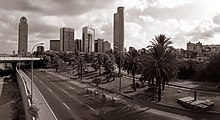
In 2007, a poll by the Israeli Democracy Institute found that 27% of Israeli Jews say that they keep the Sabbath, while 53% said they do not keep it at all. The poll too found that 50% of the respondents would give up shopping on the Sabbath as long equally public transportation were kept running and leisure activities continued to be permitted; however, only 38% believed that such a compromise would reduce the tensions between the secular and religious communities.[23]
Because the terms "secular" and "traditional" are non strictly defined, published estimates of the percentage of Israeli Jews who are considered "traditional" range from 32%[24] to 55%.[25] A Gallup survey in 2022 adamant that 65% of Israelis say they are either "non religious" or "convinced atheists", while 30% say they are "religious". Israel is in the center of the international religiosity calibration, between Thailand, the world's almost religious country, and China, the least religious.[15] The Israeli Republic Alphabetize commissioned in 2013 regarding religious affiliation of Israeli Jews found that 3.9 pct of respondents felt attached to Reform (Progressive) Judaism, three.2 percent to Conservative Judaism, and 26.5 per centum to Orthodox Judaism. The other two thirds of respondents said they felt no connectedness to any denomination, or declined to respond.[26]
Orthodox spectrum
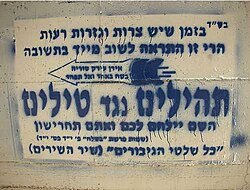
The spectrum covered by "Orthodox" in the diaspora exists in Israel, again with some important variations.
What would be chosen "Orthodox" in the diaspora includes what is usually called dati ("religious") or Haredi ("ultra-Orthodox") in Israel.[27] The erstwhile term includes what is called Religious Zionism or the "National Religious" community (and also Modern Orthodox in Us terms), every bit well every bit what has get known over the past decade or and so as Hardal (Haredi-Leumi, i. due east., "ultra-Orthodox nationalist"), which combines a largely Haredi lifestyle with a nationalist (i. east., pro-Zionist) ideology.

Haredi applies to a populace that can be roughly divided into three separate groups along both ethnic and ideological lines: (1) "Lithuanian" (i. e., non-Hasidic) Haredim of Ashkenazic (i. due east., "Germanic" - European) origin; (2) Hasidic Haredim of Ashkenazic (more often than not of Eastern European) origin; and (three) Sephardic (including mizrahi) Haredim.
There is also a growing baal teshuva (Jewish returners) movement of secular Israelis rejecting their previously secular lifestyles and choosing to go religiously observant, with many educational programs and yeshivas for them.[ citation needed ] An example is Aish HaTorah, which received open encouragement from some sectors within the Israeli establishment.
At the aforementioned time, there is also a significant movement in the opposite direction toward a secular lifestyle. At that place is some contend which tendency is stronger at present. Recent polls show that ranks of secular Jewish minority in State of israel continued to driblet in 2009. Currently, the secular make up only 42%.[28]
Non-Orthodox denominations of Judaism
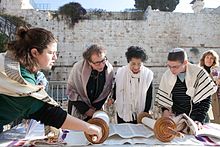
Conservative Judaism and Reform Judaism are represented amid Israeli Jews. According to The Israel Republic Plant, as of 2013, approximately 8 percentage of Israel'due south Jewish population "identified" with Reform and Conservative Judaism, a report by Pew Research Center showed 5% did,[27] while a Midgam survey showed that one tertiary "especially identified with Progressive Judaism", nearly as many as those who especially identify with Orthodox Judaism. The Principal Rabbinate strongly opposes the Reform and Conservative movements, saying they are "uprooting Judaism", that they cause assimilation and that they have "no connexion" to authentic Judaism.[29] The chief rabbinate's view does not reflect the majority viewpoint of Israeli Jews, withal. A survey of Israeli Jews published in May 2022 showed that 72 per centum of respondents said they disagreed with the Haredi assertions that Reform Jews are not really Jewish. The survey too showed that a third of Israeli Jews "identify" with progressive (Reform or Bourgeois) Judaism and well-nigh two thirds agree that Reform Judaism should take equal rights in Israel with Orthodox Judaism.[xxx] The written report was organized by the State of israel Movement for Reform and Progressive Judaism alee of its 52nd biennial conference.
Secular–religious condition quo
The religious status quo, agreed to by David Ben-Gurion with the Orthodox parties at the time of Israel'south formation in 1948, is an understanding on the function that Judaism would play in State of israel's government and the judicial system. The agreement was based upon a letter sent by Ben-Gurion to Agudat State of israel dated xix June 1947.[31] Under this agreement, which still operates in almost respects today:
- The Chief Rabbinate has authority over kashrut, Shabbat, Jewish burial and personal status issues, such as union, divorce, and conversions.
- Streets in Haredi neighborhoods are closed to traffic on the Jewish Sabbath.
- There is no public transport on the Jewish Sabbath, and most businesses are closed. Nevertheless, there is public send in Haifa, since Haifa had a large Arab population at the time of the British Mandate.
- Restaurants who wish to annunciate themselves as kosher must be certified by the Chief Rabbinate.
- Importation of non-kosher foods is prohibited. Despite this prohibition, a few pork farms supply establishments selling white meat, due to demand therefore among specific population sectors, particularly the Russian immigrants of the 1990s. Despite the status quo, the Supreme Court ruled in 2004 that local governments are not allowed to ban the sale of pork, although this had previously been a common by-law.
Nevertheless, some breaches of the status quo take get prevalent, such as several suburban malls remaining open during the Sabbath. Though this is reverse to the law, the regime largely turns a blind eye.
While the state of Israel enables liberty of religion for all of its citizens, it does not enable civil spousal relationship. The state forbids and disapproves of any civil marriages or non-religious divorces performed among within the state. Because of this, some Israelis choose to marry outside of State of israel. Many parts of the "condition quo" have been challenged past secular Israelis regarding the Chief Rabbinate'southward strict command over Jewish weddings, Jewish divorce proceedings, conversions, and the question of who is a Jew for the purposes of immigration.
The Ministry of Education manages the secular and Orthodox school networks of various faiths in parallel, with a limited degree of independence and a common core curriculum.
In recent years, perceived frustration with the status quo among the secular population has strengthened parties such as Shinui, which abet separation of religion and land, without much success so far.
Today the secular Israeli Jews claim that they aren't religious and don't observe Jewish law, and that Israel as a democratic modern country should not force the observance thereof upon its citizens confronting their volition. The Orthodox Israeli Jews merits that the separation between state and religion will contribute to the end of Israel's Jewish identity.
Signs of the get-go challenge to the condition quo came in 1977, with the fall of the Labor government that had been in power since independence, and the germination of a right-wing coalition under Menachem Begin. Right-wing Revisionist Zionism had always been more acceptable to the Orthodox parties, since information technology did non share the aforementioned history of anti-religious rhetoric that marked socialist Zionism. Furthermore, Begin needed the Haredi members of the Knesset (Israel's unicameral parliament) to form his coalition, and offered more power and benefits to their customs than what they had been accustomed to receiving, including a lifting of the numerical limit on armed forces exemptions for those engaged in full-fourth dimension Torah report.[ commendation needed ]
On the other paw, secular Israelis began questioning whether a "status quo" based on the conditions of the 1940s and 1950s was even so relevant in the 1980s and 1990s, and reckoned that they had cultural and institutional support to enable them to change it regardless of its relevance. They challenged Orthodox command of personal affairs such as marriage and divorce, resented the lack of entertainment and transportation options on the Jewish Sabbath (then the country's only twenty-four hours of rest), and questioned whether the brunt of war machine service was existence shared equitably, since the 400 scholars who originally benefited from the exemption, had grown to fifty,000[ citation needed ]. Finally, the Progressive and Conservative communities, though still small, began to exert themselves equally an alternative to the Haredi control of religious issues. No 1 was happy with the "condition quo"; the Orthodox used their newfound political force to effort to extend religious control, and the non-Orthodox sought to reduce or fifty-fifty eliminate it.[ citation needed ]
In 2010 a report released by the Israel Central Bureau of Statistics showed that viii% of Israel's Jewish population defines itself as ultra-Orthodox, 12% as Orthodox, 13% as traditional-religious, 25% as traditional, and 42% as secular, on a descending scale of religiosity. Among the Arab population it showed that 8% define themselves equally very religious, 47% as religious, 27% as non very religious, and xviii% as non religious.[32]
Principal Rabbinate
It was during the British Mandate of Palestine that the British administration established an official dual Ashkenazi-Sephardi "Principal Rabbinate" (rabbanut harashit) that was exclusively Orthodox, as function of an effort to consolidate and organize Jewish life based on its own model in United kingdom, which encouraged strict loyalty to the British crown, and in gild to attempt to influence the religious life of the Jews in Palestine in a like fashion.[ citation needed ] In 1921, Rabbi Abraham Isaac Kook (1864–1935) was chosen as the first Ashkenazi Chief Rabbi and Rabbi Jacob Meir as the start Sephardi Primary Rabbi (Rishon LeTzion). Rabbi Kook was a leading low-cal of the religious Zionist motion, and was acknowledged by all every bit a cracking rabbi of his generation. He believed that the work of secular Jews toward creating an eventual Jewish state in Eretz Yisrael was part of a divine plan for the settlement of the land of Israel. The return to Israel was in Kook's view non but a political phenomenon to save Jews from persecution, but an event of extraordinary historical and theological significance.[ citation needed ]

Prior to the 1917 British conquest of Palestine, the Ottomans had recognized the leading rabbis of the Quondam Yishuv equally the official leaders of the pocket-size Jewish customs that for many centuries consisted mostly of the devoutly Orthodox Jews from Eastern Europe likewise every bit those from the Levant who had made aliyah to the Holy Land, primarily for religious reasons. The European immigrants had unified themselves in an organization initially known every bit the Vaad Ha'ir, which later inverse its name to Edah HaChareidis. The Turks viewed the local rabbis of Palestine every bit extensions of their own Orthodox Hakham Bashis ("[Turkish] Chief Rabbi/s") who were loyal to the Sultan.[ citation needed ]
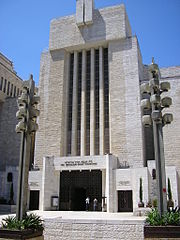
Thus the centrality of an Orthodox dominated Principal Rabbinate became part of the new state of Israel as well when it was established in 1948.[ commendation needed ]Based in its cardinal offices at Heichal Shlomo in Jerusalem the Israeli Chief rabbinate has continued to wield exclusive control over all the Jewish religious aspects of the secular state of State of israel. Through a circuitous system of "communication and consent" from a variety of senior rabbis and influential politicians, each Israeli city and town also gets to elect its own local Orthodox Chief Rabbi who is looked upwardly to by substantial regional and even national religious and even non-religious Israeli Jews.[ commendation needed ]
Through a national network of Batei Din ("religious courts"), each headed only by approved Orthodox Av Beit Din judges, as well as a network of "Religious Councils" that are part of each municipality, the Israeli Main Rabbinate retains exclusive control and has the final say in the state about about all matters pertaining to conversion to Judaism, the Kosher certification of foods, the status of Jewish marriages and divorces, and monitoring and acting when called upon to supervise the observance of some laws relating to Shabbat observance, Passover (especially when issues concerning the sale or ownership of Chametz come upward), the observance of the Sabbatical year and the Jubilee year in the agricultural sphere.[ citation needed ]
The State of israel Defense Forces also relies on the Chief Rabbinate'due south approval for its own Jewish chaplains who are exclusively Orthodox. The IDF has a number of units that cater to the unique religious requirements of the Religious Zionist yeshiva students through the Hesder program of combined alternate military service and yeshiva studies over several years.[ commendation needed ]
A poll conducted by the Israel Republic Institute in April and May 2022 of which institutions were most and least trusted by Israeli citizens showed that Israelis take little trust in the religious institution. When asked which public institutions they most trusted, the Main Rabbinate at 29% was one of the least trusted.[33]
Karaite Judaism
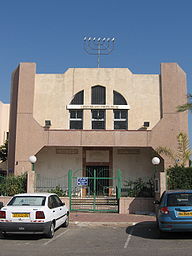
The Karaites are an ancient Jewish community that practices a form of Judaism singled-out from Rabbinical Judaism, dating ostensibly to between the 7th and 9th centuries based on textual bear witness,[34] [35] [36] though they merits a tradition at least as one-time as other forms of Judaism with some tracing their origins to the Masoretes and the Sadducees. In one case making up a significant proportion[ clarification needed ] of the Jewish population,[37] they are at present an extreme minority compared to Rabbinical Judaism. Nearly the entirety of their population, between 30,000 and fifty,000, currently alive in Israel,[38] and reside mainly in Ramla, Ashdod and Beer-Sheva. There are an estimated 10,000 additional Karaites living elsewhere effectually the world, mainly in the United states, Turkey,[38] Poland,[39] and elsewhere in Europe.
Conversion process
On 7 December 2016, the chief rabbis of Israel issued a new policy requiring that foreign Jewish converts be recognized in Israel, and vowed to release criteria required for recognizing rabbis who perform such conversions.[40] Previously, such conversions were not required to be recognized.[40] However, inside one week the chief rabbis had retracted their earlier hope and instead appointed members to a joint committee of five rabbis who would codify the conversion criteria.[41]
Samaritans
Israel is home to the only significant populations of Samaritans in the world. As of 1 Nov 2007, at that place were 712 Samaritans.[42] The community lives about exclusively in Kiryat Luza on Mount Gerizim and in Holon. Their traditional religious leader is the Samaritan High Priest, currently Aabed-El ben Asher ben Matzliach. Ancestrally, they claim descent from a grouping of Israelite inhabitants from the tribes of Joseph (divided between the two "one-half tribes" of Ephraim and Manasseh), and the priestly tribe of Levi.[43] Despite being counted separately in the census, for the purposes of citizenship, the Israeli Main Rabbinate has classified them as Jews according to police.[44]
Christianity

Most Christians living permanently in Israel are Arabs, or accept come from other countries to live and work mainly in churches or monasteries, which have long and enduring histories in the state.[ commendation needed ] Ten churches are officially recognized under Israel's confessional system, which provides for the self-regulation of status issues, such as marriage and divorce. These are the Roman (Latin rite), Armenian, Syriac, Chaldean, Melkite (Greek Catholic) and Maronite Catholic churches, Eastern Orthodox Greek Orthodox Church, and Syriac Orthodox churches, equally well every bit Anglicanism.[3]
Christian Arabs are i of the about educated groups in Israel. Maariv has described the Christian-Arab sector as "the most successful in the education system",[46] since Christian Arabs fared the best in terms of education in comparison to any other group receiving an education in Israel.[47] Arab Christians were also the vanguard in terms of eligibility for higher education,[47] and they accept attained bachelor's and academic degrees at college rates than Jews, Druze or Muslims in Israel.[47]
According to historical and traditional sources, Jesus lived in the Land of Israel, and died and was cached on the site of the Church of the Holy Sepulchre in Jerusalem, making the land a Holy Land for Christianity. Withal, few Christians now live in the surface area, compared to Muslims and Jews. This is because Islam displaced Christianity in most all of the Middle East, and the ascent of mod Zionism and the establishment of the Country of Israel has seen millions of Jews drift to Israel. Recently, the Christian population in State of israel has increased with the immigration of foreign workers from a number of countries, and the immigration of accompanying non-Jewish spouses in mixed marriages. Numerous churches have opened in Tel Aviv.[48]
Eastern Orthodox and Roman Catholic churches

Almost Christians in Israel belong primarily to branches of the Eastern Orthodox and Roman Cosmic churches that oversee a variety of church buildings, monasteries, seminaries, and religious institutions all over the country, particularly in Jerusalem.[ citation needed ]
Protestants
Protestant Christians account for less than one percentage of Israeli citizens, merely strange evangelical Protestants are a prominent source of political support for the Land of State of israel (encounter Christian Zionism).[49] Each year hundreds of thousands of Protestant Christians come as tourists to meet Israel.[50]
Messianic Judaism

The Messianic Seal of Jerusalem, a symbol of Messianic Judaism
Messianic Judaism is a religious movement that incorporates elements of Judaism with the tenets of Christianity. They worship God the Male parent as one with Trinity. They worship Jesus, whom they telephone call "Yeshua". Messianic Jews believe that Jesus is the Messiah.[51] They emphasise that Jesus was a Jew, every bit were his early followers. Near adherents in Israel reject traditional Christianity and its symbols, in favour of celebrating Jewish festivals. Although followers of Messianic Judaism are not considered Jews under State of israel's Law of Return,[52] there are an estimated 10,000 adherents in the State of State of israel, both Jews and other not-Arab Israelis, many of them contempo immigrants from the one-time Soviet Union.[53] In Jerusalem, there are twelve Messianic congregations[54] [ failed verification ]. On 23 Feb 2007, Israel Aqueduct two News released a news documentary about the growing number of Messianic Jews in Israel.[55] In Israel Jewish Christians themselves, go past the proper noun Meshiykhiyyim (from Messiah, as plant in the Franz Delitzsch Hebrew New Testament) rather than the traditional Talmudic name for Christians Notzrim (from Nazarene).[56] [57]
Islam

Foundation Rock in the Dome of the Rock

Jerusalem is a city of major religious significance for Muslims worldwide. After capturing the Quondam Metropolis of Jerusalem in 1967, Israel found itself in command of Mount Moriah, which was the site of both Jewish temples and Islam's 3rd holiest site, subsequently those in Mecca and Medina in Saudi Arabia: The Haram al Sharif (Temple Mount) from which Muslims believe that Mohammad ascended to Sky. This mountain, which has the Dome of the Rock and the adjacent Al-Aqsa Mosque on information technology, is the third-holiest site in Islam (and the holiest in Judaism). Since 1967, the Israeli government has granted potency to a Waqf to administer the area. Rumors that the Israeli government are seeking to demolish the Muslim sites have angered Muslims. These beliefs are possibly related to excavations that have been taking place shut to the Temple Mount, with the intention of gathering archeological remnants of the first and 2nd temple flow,[58] [59] likewise every bit the opinion of some rabbis and activists who call for its destruction to replace it with the Third Temple.[sixty]
Most Muslims in Israel are Sunni Arabs with a small minority of Ahmadi Arabs.[61] From 1516 to 1917, the Sunni Ottoman Turks ruled the areas that now include Israel. Their rulership reinforced and ensured the centrality and importance of Islam every bit the dominant religion in the region. The conquest of Palestine by the British in 1917 and the subsequent Balfour Announcement opened the gates for the arrival of large numbers of Jews in Palestine who began to tip the scales in favor of Judaism with the passing of each decade. However, the British transferred the symbolic Islamic governance of the land to the Hashemites based in Jordan, and not to the House of Saud. The Hashemites thus became the official guardians of the Islamic holy places of Jerusalem and the areas around it, particularly strong when Jordan controlled the West Bank (1948–1967).
In 1922 the British had created the Supreme Muslim Quango in the British Mandate of Palestine and appointed Amin al-Husayni (1895–1974) as the Grand Mufti of Jerusalem. The council was disbanded past Jordan in 1951.[ citation needed ] Israeli Muslims are free to teach Islam to their children in their ain schools, and at that place are a number of Islamic universities and colleges in Israel and the territories. Islamic constabulary remains the constabulary for concerns relating to, for example, marriage, divorce, inheritance and other family matters relating to Muslims, without the need for formal recognition arrangements of the kind extended to the primary Christian churches. Similarly Ottoman constabulary, in the form of the Mecelle, for a long time remained the ground of large parts of Israeli law, for example concerning land buying.[62]
Ahmadiyya
Ahmadiyya is a small Islamic sect in Israel. The history of the Ahmadiyya Muslim Community in Israel begins with a bout of the Middle East in 1924 made by the second caliph of the Community Mirza Basheer-ud-Din Mahmood Ahmad and a number of missionaries. However, the Customs was get-go established in the region in 1928, in what was and so the British Mandate of Palestine. The starting time converts to the movement belonged to the Odeh tribe who originated from Ni'lin, a small village near Jerusalem. In the 1950s they settled in Kababir, a former village which was later absorbed by the city of Haifa.[63] The neighbourhood'southward first mosque was built in 1931, and a larger one, called the Mahmood Mosque, in the 1980s. Israel is the but state in the Middle East where Ahmadi Muslims can openly practice their Islamic religion. As such, Kababir, a neighbourhood on Mount Carmel in Haifa, State of israel, acts every bit the Centre Eastern headquarters of the Community.[64] [65] Information technology is unknown how many Israeli Ahmadis in that location are, although it is estimated there are nigh 2,200 Ahmadis in Kababir.[66]
Druze

Israel is home to about 143,000 Druze who follow their own gnostic religion.[67] Cocky described every bit "Ahl al-Tawhid", and "al-Muwaḥḥidūn" (meaning "People of Oneness", and "Unitarians", respectively), the Druze live mainly in the Northern District, southern Haifa Commune, and northern occupied Golan Heights.[68] Since 1957, the Israeli regime has as well designated the Druze a distinct indigenous community, at the request of the customs'southward leaders. Until his expiry in 1993, the Druze community in Israel was led past Shaykh Amin Tarif, a charismatic figure regarded by many within the Druze community internationally as the preeminent religious leader of his time.[69] Even though the faith originally developed out of Ismaili Islam, Druze do not place as Muslims,[seventy] [71] [72] [73] [74] and they practise non accept the five pillars of Islam.[75]
Baháʼí Religion
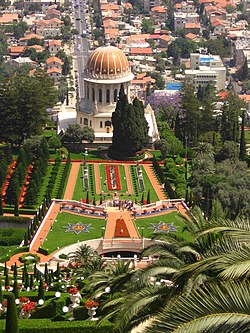

The Baháʼí Arc from the International Archives edifice
The Baháʼí Faith has its authoritative and spiritual heart in Haifa on country it has owned since Bahá'u'lláh's imprisonment in Acre in the early on 1870s by the Ottoman Empire.[ citation needed ] The progress of these backdrop in construction projects was welcomed past the mayor of Haifa Amram Mitzna (1993–2003).[76] As far back as 1969 a presence of Baháʼís was noted mostly centered effectually Haifa in Israeli publications.[77] Several newspapers in Israel since and then have noted the presence of Baháʼís in the Haifa area of some half dozen-700 volunteers with no salaries, getting only living allowances and housing,[78] [79] and that if an Israeli citizen were to wish to convert they would be told that "the religion does not seek or accept converts in the State of Israel"[79] [80] and that if they persist it is a personal matter betwixt them and God and not a matter of joining a customs of believers.[79] Baháʼís more often than not practice a "staunch political quietism"[76] and "practise non appoint in whatsoever missionary activeness in Israel".[76] Even Baháʼís from exterior Israel are instructed to non "teach" the religion to citizens of Israel.[81] The religion's state of affairs in Israel was specified in an agreement signed in 1987 by then Vice-Premier and Foreign Minister, Shimon Peres as a "recognized religious customs in State of israel", that the "holiest places of the Baháʼí Organized religion, … are located in Israel, and confirms that the Universal House of Justice is the Trustee of the Baháʼí International Community over the Holy Places of the Baháʼí Faith in Israel and over the Bahá'í endowments in Israel".[82] Every bit such, self-identifying every bit Baháʼís have been noted in Israel:[ citation needed ] in 1990 World Christian Encyclopedia estimated there were nine,500 Baháʼís; in 2000 near fourteen,000 were reported,[83] and they go along to grow.[84] Baháʼís from other countries, wishing to visit Israel, are required to seek written permission from the Universal House of Justice prior to their visit for Baháʼí pilgrimage.[85]
Hindus
The pocket-size Hindu community in Israel is more often than not made upwards of representatives of the International Order for Krishna Consciousness. In 2002, most of the devotees lived in Katzir-Harish.[86]
Neopagans
Although the exact number of adherents are unknown (1 erstwhile estimate was 150 total), primarily due to societal stigma and persecution, a growing number of young Israelis are secretly reviving the pre-Judaic polytheistic worship of ancient Canaanite gods known as Semitic neopaganism. Additionally, others worship in unlike neopagan traditions such as Celtic, Norse, and Wiccan.[87]
African Hebrew Israelites of Jerusalem
Sanctity of certain sites
Jerusalem
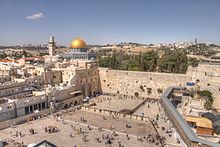
The Western Wall and Dome of the Rock, on height of the Temple Mount
Jerusalem plays an important role in three monotheistic religions — Judaism, Christianity, and Islam — and Haifa and Acre play a function in a 4th, Baháʼí. Mount Gerizim is a holy site to what can exist considered a fifth, Samaritanism. The 2000 Statistical Yearbook of Jerusalem lists 1204 synagogues, 158 churches, and 73 mosques within the city.[88] Despite efforts to maintain peaceful religious coexistence, some sites, such every bit the Temple Mount, have been a continuous source of friction and controversy. Jerusalem has been sacred to the Jews since the tenth century BC. The Western Wall, a remnant of the Second Temple, is a holy site for Jews, second only to the Temple Mount itself.[89]
Christianity reveres Jerusalem not only for its role in the Erstwhile Testament but also for its significance in the life of Jesus. The land currently occupied by the Church of the Holy Sepulchre is considered 1 of the tiptop candidates for Golgotha and thus has been a Christian pilgrimage site for the by ii 1000 years.[90] [91] In 1889, the Ottoman Empire allowed the Catholic Church to re-establish its hierarchy in Palestine. Other ancient churches, such as the Greek, Armenian, Syrian, and Coptic churches are also well represented in Jerusalem.[92]
Despite non being explicitly mentioned in the Quran, Jerusalem is the third-holiest urban center in Islam, after Mecca and Medina.[93] [94] The Temple Mountain is topped by two Islamic landmarks intended to commemorate the event — al-Aqsa Mosque, derived from the proper noun mentioned in the Quran, and the Dome of the Rock, which stands over the Foundation Stone, from which Muslims believe Muhammad ascended to Sky.[95]
Other sites
As for the importance of Haifa and Acre in Baháʼí Faith, it is related to Bahá'u'lláh, who was imprisoned in Acre and spent his final years there.
Mountain Gerizim is the holiest site to Samaritans, who used it as the site of their temple.
Religious relations
The State of israel mostly respects freedom of religion. Freedom Business firm reports: "Liberty of religion is respected. Each customs has jurisdiction over its ain members in matters of matrimony, burial, and divorce."
Religious tensions exist between Jewish haredi and non-haredi Israeli Jews. Haredi Israeli males devote their young machismo to full-time Talmudic studies and therefore mostly get exemptions from military machine service in the Israel Defence force Forces. Many leaders of haredi Judaism encourage these students to employ for exemptions from the mandatory ground forces service, ostensibly to protect them from the secularizing influence of the Israeli army. Over the years, the number of exemptions has grown to about 10% of conscriptable manpower. Many secular Israelis consider these exemptions to be a systematic shirking of their patriotic duty by a big segment of society.[ citation needed ]
Haredi Israelis are represented past haredi political parties, which like all smaller parties in a system of proportional representation may tend to wield disproportionate political power at the point when authorities coalitions need to be negotiated following national elections. As of June 2008[update], the two main Haredi parties in the Knesset are Shas, representing Sephardi and Mizrahi interests, and United Torah Judaism, an alliance of Degel HaTorah (Lithuanian Haredi) and Agudath Yisrael. The Shinui party was created as a backlash to the perceived influence of the haredi parties, and to represent the interests of secular Jews that supposedly were non seen to by the other non-religious parties.[ citation needed ]
Tension also exists betwixt the Orthodox establishment and the Bourgeois and Reform movements. Only Orthodox Judaism is officially recognized in Israel (though conversions conducted past Conservative and Reform clergy outside of State of israel may exist accepted for the purposes of the Law of Render). Equally a result, Conservative and Reform synagogues receive minimal government funding and support. Conservative and Reform rabbis cannot officiate at religious ceremonies and any marriages, divorces, and conversions they perform are non considered valid. Bourgeois and Reform Jews have been prohibited from holding services at the Western Wall on the grounds that they violate Orthodox norms regarding participation of women.[ commendation needed ]
Tensions exist surrounding Mehadrin charabanc lines, a type of bus line in Israel which mostly runs in and/or betwixt major Haredi population centers, in which gender segregation are practical. Non-Haredi female passengers have complained of existence harassed and forced to sit at the dorsum of the bus.[96] In a ruling of January 2011, the Israeli Loftier Court of Justice stated the unlawfulness of gender segregation and abolished the "mehadrin" public buses. Nevertheless, the courtroom dominion allowed the continuation of the gender segregation in public buses on a strictly voluntary basis for a one-twelvemonth experimental menses.[97]
Between Jews and Christians
Messianic Jews who are members of Messianic congregations are amid the near active missionary movements in Israel. Their proselytising has faced demonstrations and intermittent protests past the Haredi anti-missionary group Yad LeAchim, which infiltrates those movements, besides as other proselytising groups including Hare Krishna and Scientology, and maintains extensive records on their activities. Attempts past Messianic Jews to deliver other Jews are seen by many religious Jews every bit incitement to "avodah zarah" (foreign worship or idolatry). Over the years there have been several arson attempts of messianic congregations.[98] There take also been attacks on Messianic Jews and hundreds of New Testaments distributed in Or Yehuda were burned.[99] While missionary activity itself is not illegal in State of israel, it is illegal to offering money or other material inducements. Legislation banning missionary work outright has been attempted in the past.[100]
Some Orthodox Jewish communities in Israel have come under scrutiny for the negative stereotyping and scapegoating of Christian minorities in the region, including violent acts against Christian missionaries and communities.[101] A frequent complaint of Christian clergy in Israel is beingness spat at by Jews, often haredi yeshiva students.[102] The Anti-Defamation League has called on the chief Rabbis to speak out against interfaith assaults.[103] In January 2010, Christian leaders, Israeli Strange ministry staff, representatives of the Jerusalem municipality and the Haredi community met to discuss the problem. The Haredi Community Tribunal of Justice published a statement condemning the practice, stating that it was a "desecration of God's name". Several events were planned in 2010 past the liberal Orthodox Yedidya congregation to evidence solidarity with Christians and improve relations between the Haredi and Christian communities of Jerusalem.[ citation needed ]
Marriage and divorce
Currently, State of israel issues matrimony licenses if performed nether an official religious authorisation (whether it be Orthodox Jewish, Christian, Muslim, Druze, etc.) only between a man and a woman of the aforementioned religion. Civil marriages were officially sanctioned just if performed abroad, just 2010 changes in Israeli constabulary allow secular marriage in Israel for people that have proven to lack whatever religion too.[104] [105] This is a major consequence among secular groups, every bit well as adherents to non-Orthodox streams of Judaism. There is fear that civil union will divide the Jewish people in Israel between those who can marry Jews and those who cannot, leading to concerns over retaining the grapheme of the Jewish state.
Relative sizes of the religious communities in Israel
The census results are in thousands.[107] [108] [5]
| Year | Druze | % | Christians | % | Muslims | % | Jews | % | Total |
|---|---|---|---|---|---|---|---|---|---|
| 1948 | ... | ... | ... | 758.seven | ... | ||||
| 1950 | fifteen.0 | 1.09 | 36.0 | 2.63 | 116.1 | 8.47 | one,203.0 | 87.80 | 1,370.1 |
| 1960 | 23.three | i.08 | 49.6 | 2.31 | 166.3 | seven.73 | 1,911.iii | 88.88 | 2,150.4 |
| 1970 | 35.nine | i.nineteen | 75.5 | 2.fifty | 328.half dozen | x.87 | 2,582.0 | 85.44 | 3,022.1 |
| 1980 | 50.7 | one.29 | 89.9 | 2.29 | 498.3 | 12.71 | 3,282.7 | 83.71 | 3,921.7 |
| 1990 | 82.6 | ane.71 | 114.7 | ii.38 | 677.7 | fourteen.05 | 3,946.7 | 81.85 | four,821.vii |
| 2000 | 103.8 | i.63 | 135.1 | 2.12 | 970.0 | fifteen.23 | four,955.4 | 77.80 | 6,369.iii |
| 2010 | 127.5 | 1.66 | 153.iv | 1.99 | 1,320.v | 17.sixteen | five,802.4 | 75.40 | seven,695.1 |
| 2011 | 129.eight | 1.66 | 155.1 | ane.98 | ane,354.3 | 17.28 | 5,907.5 | 75.38 | 7,836.vi |
| 2012 | 131.5 | 1.65 | 158.4 | 1.98 | 1,387.five | 17.38 | 5,999.six | 75.14 | 7,984.5 |
| 2013 | 133.iv | 1.64 | 160.9 | one.98 | 1,420.3 | 17.46 | 6,104.v | 75.04 | eight,134.v |
| 2014 | 135.4 | ane.63 | 163.five | 1.97 | 1,453.8 | 17.52 | six,219.2 | 74.96 | 8,296.ix |
| 2015 | 137.3 | 1.62 | 165.9 | 1.96 | ane,488.0 | 17.58 | 6,334.5 | 74.84 | viii,463.4 |
| 2016 | 139.3 | 1.61 | 168.3 | 1.95 | 1,524.0 | 17.66 | 6,446.1 | 74.71 | 8,628.6 |
| 2017 | 141.2 | one.60 | 171.nine | one.95 | one,561.7 | 17.75 | 6,554.five | 74.50 | 8,797.ix |
| 2019 | 143.0 | 1.59 | 180.iv | 2.0 | 1,605.7 | 17.80 | vi,697.0 | 74.24 | 9,021.0 |
In 2011, non-Arab Christians, estimated to number 25,000, were counted as "Jews and others".[109]
Come across also
- Demographics of Israel
- Culture of State of israel
- Hesder
- Jewish denominations
- Palestinian Christians
- Sherut Leumi
- Condition quo (Israel)
- Tal committee
References
- ^ "State of israel'due south Religiously Divided Social club". Pew Inquiry Center'due south Organized religion & Public Life Projection. eight March 2016. Retrieved 23 February 2020.
- ^ Sheetrit, Shimon (xx Baronial 2001). "Liberty of Religion in Israel". State of israel Ministry of Foreign Affairs. Archived from the original on vi Feb 2013. Retrieved 26 Oct 2008.
- ^ a b "Freedom of Religion in Israel". www.jewishvirtuallibrary.org . Retrieved 16 May 2017.
- ^ "Learn More than - The Bahá'í Gardens". www.ganbahai.org.il . Retrieved 1 Nov 2020.
- ^ a b c State of israel's Independence Day 2019 (PDF) (Report). Israel Key Bureau of Statistics. 6 May 2019. Retrieved vii May 2019.
- ^ a b "Table 2.one — Population, by Organized religion and Population. Every bit of may 2011 approximate the population was 76.0 Jewish. Group". Statistical Abstract of Israel 2006 (No. 57). Israel Central Bureau of Statistics. 2006. Archived from the original (PDF) on xiv September 2012.
- ^ "PEOPLE: Religious Freedom". mfa.gov.il . Retrieved 27 April 2021.
- ^ "Basic Law: Human being Nobility and Freedom".
- ^ "Global Restrictions on Faith (Full report)" (PDF). The Pew Forum on Faith & Public Life. Dec 2009. Archived from the original (PDF) on three March 2016. Retrieved 12 September 2013.
- ^ "U.Southward. Section of State: 2012 Report on International Religious Freedom: Israel and The Occupied Territories (May 20, 2013)"
- ^ "ISRAEL 2022 INTERNATIONAL RELIGIOUS Liberty Written report". U.S. Department of Justice . Retrieved 27 Apr 2021.
- ^ "Israel Has Almost as Many Religious Restrictions as Iran, Pew Report Finds". Haaretz, JTA and Ben Sales. July 17, 2019
- ^ Newman, Marissa. "Israel pushes back on Usa report spotlighting religious freedom woes". www.timesofisrael.com . Retrieved 27 April 2021.
- ^ "State of israel and the Occupied Territories". U.South. Department of State.
- ^ a b Who are the about religious people in the world? Haaretz, 14 Apr 2015
- ^ [1] (in Hebrew)
- ^ "A Portrait of Israeli Jewry: Beliefs, Observances, and Values among Israeli Jews 2000" (PDF). The Israel Commonwealth Found and The AVI CHAI Foundation. 2002. p. 8. Archived from the original (PDF) on 30 June 2007. Retrieved 28 Jan 2008.
- ^ Ib. p.11
- ^ "Pinnacle l Countries With Highest Proportion of Atheists / Agnostics". Adherents.com. 27 March 2005. Archived from the original on 22 August 2009. Retrieved 25 February 2007.
{{cite web}}: CS1 maint: unfit URL (link) - ^ Hasson, Nir (27 Jan 2012). "Survey: Record Number of Israeli Jews Believe in God". Haaretz.
- ^ Moti Bassok (25 December 2007). "Cardinal Agency of Statistics: 2.1% of land'due south population is Christian". HAARETZ.com. Retrieved 29 January 2008.
- ^ "Population, by Population Group" (PDF). Monthly Bulletin of Statistics. Israel Central Bureau of Statistics. 31 December 2013. Archived from the original (PDF) on iii February 2014. Retrieved 17 February 2014.
- ^ "Sabbath Poll", Dateline World Jewry, World Jewish Congress, September 2007
- ^ "Freedom of Religion". BICOM. Archived from the original on 21 Dec 2005. Retrieved 14 October 2005.
- ^ Daniel J. Elazar. "How Religious are Israeli Jews?". Jerusalem Center for Public Diplomacy. Retrieved 28 Jan 2008.
- ^ Poll: 7.1 percent of Israeli Jews define themselves as Reform or Conservative Haaretz, eleven June 2013
- ^ a b Lipka, Michael (15 March 2016). "Dissimilar U.South., few Jews in Israel place every bit Reform or Conservative". Pew Research Center.
- ^ Shtull-Trauring, Asaf (17 May 2010). "Poll Shows Ranks of Secular Jewish Minority in Israel Continued to Drop in 2009". Haaretz.
- ^ By JEREMY SHARON, SAM SOKOL (25 February 2016). "Chief Rabbinate in vehement attack on Reform, Conservative movements". Jerusalem Postal service . Retrieved 27 April 2016.
- ^ Survey: Bulk of Israeli Jews support equality for Reform movement JTA, 27 May 2016.
- ^ The Status Quo Alphabetic character (Dr. Archived sixteen July 2011 at the Wayback Auto) (in Hebrew) English translation in Israel in the Middle East: Documents and Readings on Society, Politics, and Foreign Relations, Pre-1948 to the Present, editors Itamar Rabinovich and Jehuda Reinharz. ISBN 978-0-87451-962-four
- ^ "Israel 2010: 42% of Jews are secular". Ynetnews. eighteen May 2010.
- ^ "Tamar Pileggi 'Jews and Arabs proud to be Israeli, distrust government: Poll conducted before war shows marked ascension in support for state amid Arabs; religious establishment scores low on trust' (iv Jan 2015) The Times of Israel" http://www.timesofisrael.com/jews-and-arabs-proud-to-be-israeli-distrust-government/
- ^ Mourad El-Kodsi, The Karaite Jews of Egypt, 1987.
- ^ Ash-Shubban Al-Qarra'in 4, two June 1937, p. 8.
- ^ Oesterley, W. O. E. & Box, K. H. (1920) A Curt Survey of the Literature of Rabbinical and Mediæval Judaism, Burt Franklin:New York.
- ^ A. J. Jacobs, The Year of Living Biblically, p. 69.
- ^ a b Isabel Kershner, "New Generation of Jewish Sect Takes Up Struggle to Protect Place in Modern Israel", The New York Times, 4 September 2013.
- ^ "Charakterystyka mniejszości narodowych i etnicznych w Polsce" (in Smoothen). Warsaw: Ministerstwo Spraw Wewnętrznych (Smoothen Interior Ministry). Retrieved vii April 2012.
- ^ a b Maltz, Judy (8 December 2016). "Israel to Publish Criteria for Recognizing Rabbis Who Perform Conversions Abroad". Haaretz.
- ^ "Rabbinate forms conversion vetting panel, raising hackles anew".
- ^ "Developed Community", A.B. The Samaritan News Bi-Weekly Mag, one Nov 2007
- ^ David Noel Freedman, The Anchor Bible Dictionary, 5:941 (New York: Doubleday, 1996, c1992)
- ^ Shulamit Sela, The Caput of the Rabbanite, Karaite and Samaritan Jews: On the History of a Title, Bulletin of the School of Oriental and African Studies, University of London, Vol. 57, No. ii (1994), pp. 255-267
- ^ McMahon, Arthur. L. (1913). . In Herbermann, Charles (ed.). Catholic Encyclopedia. New York: Robert Appleton Company.
- ^ "חדשות - בארץ nrg - ...המגזר הערבי נוצרי הכי מצליח במערכת".
- ^ a b c Druckman, Yaron (23 Dec 2012). "Christians in Israel: Strong in education". Ynetnews.
- ^ Adriana Kemp & Rebeca Raijman, "Christian Zionists in the Holy Country: Evangelical Churches, Labor Migrants, and the Jewish Land", Identities: Global Studies in Ability and Culture, 10:3, 295-318
- ^ Zylstra, Sarah. "Israeli Christians Think and Do Almost the Contrary of American Evangelicals". Christianity Today . Retrieved 24 February 2018.
- ^ "Christian tourism to Israel". mfa.gov.il. Israel Ministry building of Foreign Affairs. Retrieved 24 Feb 2018.
- ^ Steiner, Rudolf; George E. Berkley (1997). Jews. Branden Books. p. 129. ISBN978-0-8283-2027-6.
A more rapidly growing organization is the Messianic Jewish Alliance of America, whose congregations assemble on Friday evening and Saturday morning, recite Hebrew prayers, and sometimes vesture talliot (prayer shawls). They worship Jesus, whom they call Yeshua.
- ^ Daphna Berman. "Aliyah with a cat, a canis familiaris and Jesus". WorldWide Religious News citing & quoting "Haaretz", 10 June 2006. Archived from the original on 17 January 2008. Retrieved 28 Jan 2008.
- ^ Larry Derfner and Ksenia Svetlova. "Messianic Jews in Israel claim 10,000". rickcross.com, citing & quoting Jerusalem Post 29 April 2005. Retrieved 28 January 2008.
- ^ "Messianic perspectives for Today". leeds Messianic fellowship. Retrieved 28 Jan 2008.
- ^ "Israel Channel 2 News - 23 February 200…". 8 April 2007. Retrieved 28 January 2008. (ix infinitesimal video, Hebrew audio, English subtitles)
- ^ Avner Falk Franks and Saracens: Reality and Fantasy in the Crusades p4 2010 - 225 "All the same, the Talmudic Hebrew proper name (as well as the modern Hebrew name) for Christians is not meshikhiyim (messianic) just notsrim (people from Nazareth), referring to the fact that Jesus came from Nazareth."
- ^ case: The Christian Church, Jaffa Tel-Aviv website article in Hebrew Archived 4 September 2011 at the Wayback Machine יהודים משיחיים - יהודים או נוצרים?
- ^ "Southern Temple Mountain".
- ^ "The Destruction of the Temple Mount Antiquities, past Mark Ami-El".
- ^ "J'lem posters call for tertiary Temple". The Jerusalem Post - JPost.com.
- ^ Ori Stendel (1996). The Arabs in Israel. Sussex Academic Press. p. 45. ISBN978-1898723240 . Retrieved ii June 2014.
- ^ Guberman, Shlomo (2000). The Evolution of the Law in Israel: The First 50 Years, State of israel Ministry of Strange Diplomacy, accessed January 2007
- ^ Emanuela C. Del Re (iii March 2014). "Approaching disharmonize the Ahmadiyya fashion: The alternative style to conflict resolution of the Ahmadiyya community in Haifa, Israel". Springer: 116.
- ^ "Kababir and Central Carmel – Multiculturalism on the Carmel". Retrieved 17 February 2015.
- ^ "Visit Haifa". Retrieved 17 February 2015.
- ^ "Kababir". Israel and Yous. Archived from the original on xxx January 2015. Retrieved 17 February 2015.
- ^ "The Druze population in Israel - a drove of data on the occasion of the Prophet Shuaib vacation" (PDF). CBS - Israel. Israel Central Bureau of Statistics. 17 April 2019. Retrieved 8 May 2019.
- ^ Identity Repertoires among Arabs in State of israel, Muhammad Amara and Izhak Schnell; Periodical of Ethnic and Migration Studies, Vol. thirty, 2004
- ^ Pace, Eric (5 October 1993). "Sheik Amin Tarif, Arab Druse Leader In Israel, Dies at 95". The New York Times . Retrieved 29 March 2010.
- ^ Pintak, Lawrence (2019). America & Islam: Soundbites, Suicide Bombs and the Road to Donald Trump. Bloomsbury Publishing. p. 86. ISBN9781788315593.
- ^ Jonas, Margaret (2011). The Templar Spirit: The Esoteric Inspiration, Rituals and Behavior of the Knights Templar. Temple Social club Publishing. p. 83. ISBN9781906999254.
[Druze] often they are not regarded as being Muslim at all, nor do all the Druze consider themselves as Muslim
- ^ "Are the Druze People Arabs or Muslims? Deciphering Who They Are". Arab America. Arab America. 8 August 2018. Retrieved 13 April 2020.
- ^ J. Stewart, Dona (2008). The Middle East Today: Political, Geographical and Cultural Perspectives. Routledge. p. 33. ISBN9781135980795.
Most Druze do not consider themselves Muslim. Historically they faced much persecution and keep their religious beliefs secrets.
- ^ Yazbeck Haddad, Yvonne (2014). The Oxford Handbook of American Islam. Oxford University Press. p. 142. ISBN9780199862634.
While they announced parallel to those of normative Islam, in the Druze organized religion they are dissimilar in meaning and interpretation. The organized religion is consider singled-out from the Ismaili as well as from other Muslims belief and practice... Well-nigh Druze consider themselves fully assimilated in American society and exercise not necessarily identify as Muslims..
- ^ De McLaurin, Ronald (1979). The Political Role of Minority Groups in the Middle E. Michigan University Printing. p. 114. ISBN9780030525964.
Theologically, one would take to conclude that the Druze are not Muslims. They practice not accept the 5 pillars of Islam. In place of these principles the Druze have instituted the seven precepts noted above.
- ^ a b c Adam Berry (22 September 2004). "The Baháʼí Faith and its relationship to Islam, Christianity, and Judaism: A brief history". International Social Scientific discipline Review. ISSN 0278-2308. Retrieved five March 2015.
- ^ Zev Vilnay; Karṭa (Firm) (1969). The new Israel atlas: Bible to nowadays day. Israel Universities Press. p. 38.
- ^ * Nechemia Meyers (1995). "Peace to all nations - Baha'is Establish Israel'south Second Holy Mountain". The World & I . Retrieved 5 March 2015.
- ^ a b c Donald H. Harrison (3 Apr 1998). "The Fourth Religion". Jewish Sightseeing. Haifa, Israel. Retrieved 5 March 2015.
- ^ Universal House of Justice (xiii January 2015). "Humanitarian Responses to Global Conflicts". Letters from the Universal Business firm of Justice. Bahai-Library.com. Retrieved v March 2015.
- ^ "Teaching the Faith in Israel". Baháʼí Library Online. 23 June 1995. Retrieved 6 August 2007.
- ^ Universal House of Justice (30 Apr 1987). "Regarding the development of the backdrop of the Bahá'í Earth Eye". Bahá'í Reference Library, Selected Messages of the Universal House of Justice. Bahá'í International Community. Retrieved 25 December 2016.
- ^ David B. Barrett, Globe Christian Encyclopedia (2001)
- ^ Global Institutions of Religion, page 88, Katherine Marshall - 2013
- ^ "Other visits to the Holy Land". Bahá'í Globe Centre. Archived from the original on 4 January 2011. Retrieved 24 March 2010.
- ^ "Waves of Devotion". 30 June 2007.
- ^ Ilany, Ofri (22 March 2009). "Paganism Returns to the Holy Land". Haaretz.
- ^ Guinn, David Due east. (2 October 2006). Protecting Jerusalem's Holy Sites: A Strategy for Negotiating a Sacred Peace (1st ed.). Cambridge University Press. p. 142. ISBN978-0-521-86662-0.
- ^ "What is the Western Wall?". The Kotel. Archived from the original on 2 February 2007. Retrieved 6 March 2007.
- ^ Ray, Stephen K. (October 2002). St. John'due south Gospel: A Bible Study Guide and Commentary for Individuals and Groups. San Francisco, CA: Ignatius Press. p. 340. ISBN978-0-89870-821-9.
- ^ O'Reilly, Sean; James O'Reilly (30 Nov 2000). PilgrFile: Adventures of the Spirit (1st ed.). Travelers' Tales. p. 14. ISBN978-1-885211-56-nine.
The general consensus is that the Church of the Holy Sepulchre marks the hill called Golgotha, and that the site of the Crucifixion and the last five Stations of the Cantankerous are located under its large black domes.
- ^ Preserving Identity in the Holy City [ dead link ]
- ^ 3rd-holiest metropolis in Islam:
- Esposito, John L. (ii November 2002). What Everyone Needs to Know near Islam . Oxford Academy Press. p. 157. ISBN978-0-xix-515713-0.
The Night Journey made Jerusalem the third holiest metropolis in Islam
- Brown, Leon Carl (15 September 2000). "Setting the Stage: Islam and Muslims". Religion and Country: The Muslim Arroyo to Politics. Columbia University Printing. p. 11. ISBN978-0-231-12038-viii.
The third holiest city of Islam—Jerusalem—is also very much in the center...
- Hoppe, Leslie J. (August 2000). The Holy City: Jerusalem in the Theology of the Old Testament. Michael Glazier Books. p. 14. ISBN978-0-8146-5081-three.
Jerusalem has e'er enjoyed a prominent place in Islam. Jerusalem is often referred to as the third holiest urban center in Islam...
- Esposito, John L. (ii November 2002). What Everyone Needs to Know near Islam . Oxford Academy Press. p. 157. ISBN978-0-xix-515713-0.
- ^ Middle Eastward peace plans by Willard A. Beling: "The Aqsa Mosque on the Temple Mount is the third holiest site in Sunni Islam afterwards Mecca and Medina".
- ^ "The Early Arab Menstruum - 638-1099". Jerusalem: Life Throughout the Ages in a Holy Metropolis. Bar-Ilan University Ingeborg Rennert Heart for Jerusalem Studies. March 1997. Retrieved 24 Apr 2007.
- ^ "Egged launches 11 'mehadrin' charabanc lines". Jerusalem Postal service. one December 2006. Archived from the original on six July 2013. Retrieved viii March 2011.
- ^ Izenberg, Dan; Mandel, Jonah (vi January 2011). "Court scraps 'mehadrin' buses". Jerusalem Mail service . Retrieved 8 March 2011.
- ^ Elaine Ruth Fletcher (26 June 2000). "Orthodox Suspected in Jerusalem Conservative Synagogue, Church building Attacks". beliefnet.com. Retrieved 28 Jan 2007.
- ^ "Orthodox Jewish youths burn New Testaments in Or Yehuda", HaAretz (Associated Press), xx May 2008
- ^ Larry Derfner (29 Apr 2005). "A matter of faith". The Jerusalem Post.
- ^ Persecution of Christians in State of israel: The New Inquisition, Journal of Palestine Studies, Vol. viii, No. 1 (Autumn, 1978), pp. 135–140
- ^ Barkat, Amiram (27 June 2009). "Christians in Jerusalem want Jews to stop spitting on them". Haaretz.
- ^ "ADL Calls On Chief Rabbis to Speak Out Confronting Interfaith Assaults In Old Urban center". 17 October 2004. Archived from the original on 29 November 2008.
- ^ "Israeli couple become first to be wed in civil union". The Jerusalem Post - JPost.com.
- ^ Armada, Josh (4 Nov 2010). "State of israel To Allow Civil Marriages". Huffington Mail service.
- ^ "Population in Israel and in Jerusalem, by Faith, 1988 - 2016" (PDF). Israel Central Agency of Statistics. four September 2018. Retrieved 10 May 2019.
- ^ "Statistical Abstruse of Israel 2017". Central Agency of Statistics.
- ^ "Statistical Abstract of Israel 2022 - No. 65 Subject 2 - Tabular array No. 2".
- ^ Juni Mansur (2012) Arab Christians in State of israel. Facts, Figures and Trends. Dyar. ISBN 978-9950-376-fourteen-4. pp.13,20
Notes
Bibliography
- Leibman, Charles South., Religious and Secular: Conflict and Accommodation Between Jews in Israel. AVICHAI, 1990
- Leibman, Charles S. and Elihu Katz, eds. The Jewishness of Israelis: Responses to the Guttman Report. SUNY Press, 1997
- Mazie, Steven V., Israel'due south College Law: Religion and Liberal Democracy in the Jewish State. Lexington Books, 2006
External links
- The Israel Project: Religious Freedom in Israel: A Fundamental Guarantee
- Israel: Faith and Society
- Pluralism: Synagogue and the Country of Israel
- M. Avrum Ehrlich, Past, Present and Future Developments of Arab Christianity in the Holy Land
Source: https://en.wikipedia.org/wiki/Religion_in_Israel
0 Response to "Percentage of Jews in Israel and Holy Land That Are Born Again Christians"
Post a Comment